

India & World UpdatesHappeningsBreaking NewsFeature Story
The Geopolitics of Rare Earth Elements: Redefining Power in the Modern World (Part-1), written by Dr. Manoj Kumar Paul
//Dr. Manoj Kumar Paul//
( Former Principal, Women’s College, Silchar)
Part-1
1. Introduction: The New Map of Power and a Changing World
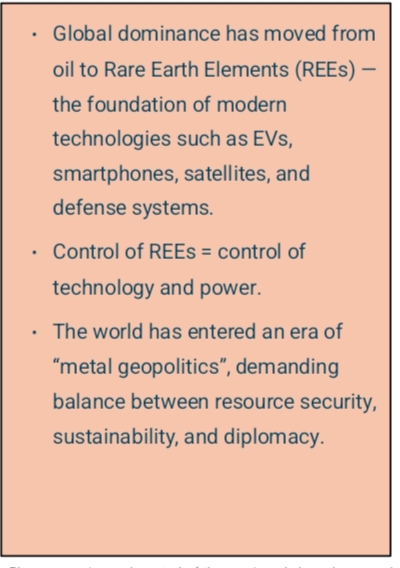
There was once a time when a nation’s wealth and power were measured by the size of its oil reserves. The Middle Eastern oil fields, for decades, dictated the contours of global economics and politics. Yet, the technology-driven civilization of the twenty-first century has fundamentally altered that paradigm. Today, oil no longer defines power; it has been replaced by Rare Earth Elements (REEs)—the indispensable raw materials behind almost every form of modern technology.
From smartphones and electric vehicles to solar panels, wind turbines, satellites, and advanced defence equipment, rare earth elements play an essential role everywhere. This transformation is not merely technological—it represents a profound geopolitical reconfiguration. The possession and control of these minerals have become decisive factors in determining economic and military strength. Consequently, global politics has transitioned from the age of “oil wars” to that of “metal wars.”
Rare earths now underpin the infrastructure of twenty-first-century innovation, making them the strategic resources of our time (U.S. Geological Survey, 2025; European Commission, 2023).
2. What Are Rare Earth Elements and Why Are They Important?
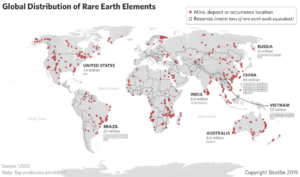
The term “Rare Earth Elements” (REEs) generally refers to a group of 17 metallic elements that include the 15 lanthanides in the periodic table along with scandium (Sc) and yttrium (Y). These are:
Lanthanide Series:
Lanthanum (La), Cerium (Ce), Praseodymium (Pr), Neodymium (Nd), Promethium (Pm), Samarium (Sm), Europium (Eu), Gadolinium (Gd), Terbium (Tb), Dysprosium (Dy), Holmium (Ho), Erbium (Er), Thulium (Tm), Ytterbium (Yb), and Lutetium (Lu); along with Scandium (Sc) and Yttrium (Y).
Although these elements are not genuinely “rare” in terms of abundance, they are difficult and costly to separate and purify due to their similar chemical properties. They are typically found mixed within minerals such as monazite, bastnäsite, and xenotime (U.S. Geological Survey, 2025).
Technological Significance
Each of these elements plays a crucial role in modern industrial and technological applications:
Neodymium (Nd) and Dysprosium (Dy): Used in high-strength permanent magnets essential for electric vehicles and wind turbines.
Lanthanum (La): Utilized in hybrid batteries and optical glass.
Yttrium (Y) and Terbium (Tb): Key materials in LED and laser technologies.
Europium (Eu): Provides red and blue phosphors in television and computer displays.
Gadolinium (Gd): Serves as a contrast agent in MRI scanners.
In essence, the technological backbone of modern civilization is built upon these elements. Their applications span from clean energy systems and digital communication to space research and advanced medical diagnostics. For this reason, rare earth elements are now regarded as critical strategic resources underpinning the technological and economic security of nations (European Commission, 2023; United Nations Environment Programme [UNEP], 2023).
3. China’s Dominance: The New Geopolitical Power Center
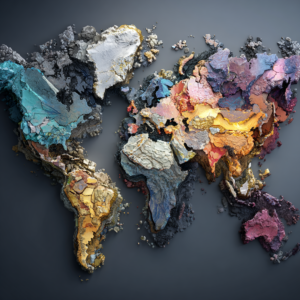
In the contemporary world, discussions of rare earth elements inevitably lead to one name—China. The country currently controls nearly 70–80% of global REE production, while its dominance in refining and processing is even higher—approximately 90% (U.S. Geological Survey, 2025; Bloomberg, 2025). This means China is not merely a supplier of raw materials but effectively the controller of the entire global supply chain.
During the 1980s, Chinese leader Deng Xiaoping made a prophetic remark: “The Middle East has oil; China has rare earths.” This was not simply a statement of economic potential—it became a strategic foundation for China’s future industrial and geopolitical ascendancy. Recognizing that the invisible power of modern technological civilization would depend on these elements, the Chinese state directly intervened to consolidate its control over mining, refining, and export operations.
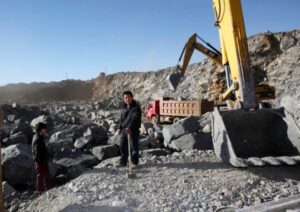
The Baotou region in Inner Mongolia now stands as the world’s largest rare earth production hub, containing around 35 million tons of reserves. From this single area, crucial elements such as cerium, neodymium, dysprosium, and terbium are extracted and refined. However, this industrial dominance has come at a severe environmental cost—the Baotou landscape Is scarred by several “toxic lakes,” filled with radioactive waste that has caused lasting ecological and human damage (UNEP, 2023).
China’s capacity to use its mineral wealth as a strategic weapon became evident in 2010, when a diplomatic dispute arose with Japan over the Senkaku Islands. In retaliation, China abruptly halted rare earth exports to Japan, causing global prices to skyrocket nearly tenfold. Japanese technology giants such as Sony, Panasonic, and Toyota faced immediate production crises, revealing the extent of the world’s dependence on Chinese minerals (Reuters, 2025).
Beyond its domestic reserves, China has also expanded outward through long-term investments in Africa, Latin America, Southeast Asia, and even Greenland. As part of the Belt and Road Initiative (BRI), Chinese companies have gained access to mines in the Democratic Republic of Congo, Myanmar, Brazil, Bolivia, and Peru, securing control over both rare earths and other “critical minerals.” This strategy has enabled China to establish a global raw material network, turning industrialized nations into dependents rather than competitors (Bloomberg, 2025).
Western geopolitical analysts describe this approach as “Resource Nationalism”—the state’s monopolistic assertion of ownership over strategic resources for political leverage (European Parliament, 2023). Consequently, the United States, the European Union, and Japan have been forced to diversify their supply chains and invest in recycling and alternative sourcing technologies.
China’s dominance has thus created a “Tech Dependency Trap”, where the global technology industry remains directly or indirectly reliant on Chinese REE supplies. As demonstrated in 2010, even a single policy shift by Beijing can send shockwaves through the global economy.
In summary, China has evolved into not only the leading power in the rare earth market but also a new geopolitical epicentre, whose influence may surpass even that once held by the oil-rich Middle East.
4. The United States’ Concerns: Technology, Defence, and Trade Pressure
The United States was once one of the world’s leading producers of rare earth elements. The Mountain Pass Mine in California, for instance, supplied nearly 40% of global REE demand during the 1980s (U.S. Geological Survey, 2025). However, during the 1990s, China’s low-cost production and weak environmental regulations undermined U.S. competitiveness. Rising environmental compliance costs eventually led to the closure of the Mountain Pass facility, allowing China to establish near-total dominance over the international market (Bloomberg, 2025).
Today, the United States imports roughly 78% of its rare earths from China, a dependency that poses serious strategic risks (Reuters, 2025). These minerals are indispensable not only for civilian technology but also for national security applications. Elements such as neodymium, lanthanum, and dysprosium are critical in the manufacturing of F-35 fighter jets, Patriot missile systems, nuclear submarines, satellite communications, jet engines, and radar systems. Even minor disruptions in REE supply could trigger significant crises in U.S. defence production (U.S. Geological Survey, 2025).
In 2025, then-President Donald Trump announced an additional 100% tariff on Chinese imports, aiming to prevent Beijing from using export restrictions as leverage over the American technology and defence sectors (Reuters, 2025). The Trump administration accused China of “weaponizing technology and mineral resources,” framing it as a direct threat to America’s economic sovereignty (The White House, 2025).
This escalation caused immediate market instability. Prices of rare earths surged by nearly 40%, adversely impacting industries such as electronics, electric vehicles, and semiconductors. Major corporations including Tesla, Intel, and General Dynamics faced increased production costs, thereby straining the broader U.S. economy (Bloomberg, 2025).
To de-escalate tensions, a preliminary trade agreement was signed in October 2025 between the U.S. Treasury and China’s Ministry of Commerce. The key provisions included:
Relaxation of China’s export restrictions on REEs.
Initiation of ownership restructuring for TikTok in the U.S. market.
Resumption of Chinese purchases of American soybeans.
Joint collaboration to combat fentanyl trafficking (The White House, 2025).
Although this deal temporarily eased market pressure, the underlying structural issue remained unresolved—China still controls nearly 90% of global REE refining capacity (U.S. Geological Survey, 2025).
To counteract this dependency, the U.S. has launched the Minerals Security Partnership (MSP) with Australia, Canada, Japan, and India, aiming to create diversified global supply chains and reduce concentration risk (Bloomberg, 2025). Concurrently, under the Defense Production Act (DPA), domestic mining projects have been revitalized in Texas, Wyoming, and Alaska, alongside major investments in environmentally friendly recycling technologies to recover REEs from used electronics (U.S. Geological Survey, 2025).
These developments indicate that rare earth elements are no longer merely natural resources; they have become the epicenter of modern geopolitics. Control over these materials equates to control over technology, military dominance, and diplomatic influence. Washington’s core anxiety is thus clear—if REE resources remain concentrated in China’s hands, the balance of global power in the twenty-first century may undergo a profound and irreversible shift.
5. Geopolitics and Global Competition
Across the contemporary world, rare earth elements (REEs) have evolved from being purely economic commodities to becoming strategic instruments of national power and diplomacy. China’s monopolistic production and advanced processing capabilities have long constrained global supply chains, prompting nations to undertake a process of strategic recalibration that integrates economic policy, military readiness, and multilateral diplomacy.
China’s Strategic Leverage
By late 2025, China further tightened its control over REE exports—expanding licensing requirements, restricting the export of certain processed materials, and imposing strict prohibitions on defense-related applications. These measures serve not only as market controls but also as diplomatic tools, enabling Beijing to extract concessions or exert pressure during high-level negotiations. The result has been significant disruptions to global industrial and defense supply networks (Reuters, 2025).
The U.S. Expansionary Response: Tariffs and Countermeasures
In response, the U.S. administration implemented a series of high-level tariffs—some reaching up to 100%—on Chinese imports during October–November 2025. These tariffs, coupled with expanded export control regulations, created turbulence in financial markets and corporate sectors alike. Amid the volatility, both sides engaged in negotiations to stabilize trade flows. As part of these talks, tentative frameworks for flexible trade and export adjustments were introduced, signaling a temporary détente while preserving strategic leverage on both sides (The White House, 2025).
Alliances and Alternative Networks: Quad, MSP, and the European Union
Faced with China’s dominance, Western and Indo-Pacific allies have intensified their efforts to establish alternative supply networks. The Minerals Security Partnership (MSP), led by the United States, and the Quad’s Critical Minerals Initiative aim to diversify supply, enhance technological cooperation, and set transparent global standards. These frameworks seek to integrate the resource and refining capabilities of Africa, Australia, Canada, and India into a reliable and transparent global chain (Bloomberg, 2025; U.S. Department of State, 2024).
Simultaneously, the European Union’s Critical Raw Materials Act (2023) outlines goals for domestic mining, refining, and recycling to reduce external dependency. Together, these initiatives represent a collective international effort to dismantle China’s monopoly and create a multipolar mineral economy (European Parliament, 2023).
Africa and Latin America: The New Arenas of Competition
China’s influence extends beyond its borders through the Belt and Road Initiative (BRI), encompassing long-term investments and mineral agreements in Africa and Latin America. In response, Western powers have sought to engage these regions through transparent investment practices, equitable tender systems, and sustainable development frameworks. This shift represents an effort to transform mineral politics from unilateral dependency into mutual partnerships that emphasize local development and environmental protection (Levin et al., 2023).
Economic and Industrial Implications: From Supply Risk to Technological Realignment
The combination of Chinese export controls and tariff escalations has forced multinational corporations to restructure their global supply chains. Companies are now diversifying raw material sources, relocating processing facilities, and investing in recycling projects. Governments, meanwhile, are promoting domestic refining capabilities and offering investment incentives to foster technological self-reliance. The overarching objective of Western and Asian economies has shifted from “de-risking” dependence on China to rebuilding resilient homegrown ecosystems in shipping, refining, and recycling (Bloomberg, 2025).
India’s Strategic and Diplomatic Reorientation
India, with its mineral-rich geography and strategic partnerships, is reconfiguring its position in the global REE landscape. Through initiatives such as the National Critical Mineral Mission and the National Rare Earth Mission, India’s Geological Survey and public-sector enterprises are expanding exploration, environmental assessment, and domestic processing capacity. Concurrently, India’s active participation in the Quad and MSP enhances its ability to attract foreign investment and technological collaboration, making its REE policy not just an economic initiative but a national security strategy (Ministry of External Affairs, 2025; Ministry of Mines, 2025).
Risks and Future Outlook
While geopolitical competition encourages diversification of supply, it also introduces new vulnerabilities. Trade wars, retaliatory export controls, and political instability in mining-dependent countries can all disrupt global supply chains. Historical precedents show how diplomatic tensions can trigger sudden price shocks and lead to escalating costs in technology sectors. Therefore, establishing a sustainable and resilient global backbone will require not only diversified sourcing but also international standards, transparent contracts, robust environmental safeguards, and the inclusion of local communities in decision-making processes.