

India & World UpdatesHappeningsBreaking NewsFeature Story
The Geopolitics of Rare Earth Elements: Redefining Power in the Modern World (part 2) written by Dr. Manoj Kumar Paul
//Dr. Manoj Kumar Paul//
( Former Principal, Women’s College, Silchar)
Part-2
6. India: Opportunities and Limitations
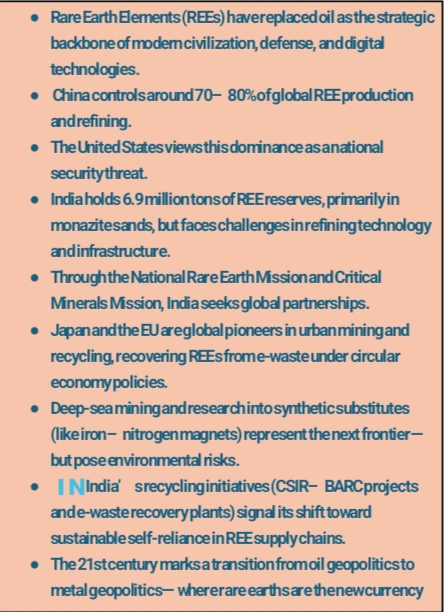
Although India currently plays a limited role in global rare earth production, it holds significant potential as an emerging power in this domain. India’s soil is estimated to contain approximately 6.9 million tons of rare earth reserves (Indian Bureau of Mines, 2024). The primary sources are the monazite sands found along the coasts of Kerala, Odisha, Tamil Nadu, and Andhra Pradesh, which are rich in lanthanum, cerium, thorium, and neodymium (Atomic Minerals Directorate for Exploration and Research, 2024). Despite these abundant resources, technological and investment-related constraints continue to impede their large-scale utilization.
Currently, the extraction and processing of REEs in India are managed by Indian Rare Earths Limited (IREL)—a state-owned enterprise under the Department of Atomic Energy, which also refines other strategic minerals such as thorium and uranium (Department of Atomic Energy, 2024). However, IREL’s operational scope remains limited, and due to the lack of advanced refining technology, much of India’s rare earth output is exported in raw form. This results in low value addition and high dependence on foreign markets (NITI Aayog, 2024).

To address these challenges, the Indian government has launched two major policy initiatives—the National Rare Earth Mission and the Critical Minerals Mission (Ministry of Mines, 2025). Their primary objectives are to boost domestic production, develop advanced processing industries, and establish technology partnerships with global firms to build modern refineries. Additionally, the Geological Survey of India (GSI) has been actively exploring new deposits in Rajasthan, Chhattisgarh, and Meghalaya (GSI, 2025).
Nevertheless, geological abundance alone is not sufficient. As experts note, India’s lag lies in technological sophistication, policy integration, and industrial infrastructure. Without substantial investment in refining technology, reform of environmental regulations, and active private sector participation, India may find it difficult to emerge as a major player in the REE market (NITI Aayog, 2024).
Despite these limitations, India’s strategic positioning makes it an important alternative source in the global supply network. Through its participation in the Minerals Security Partnership (MSP)—alongside the United States, Japan, and Australia—India aims to play a pivotal role in sustainable extraction, eco-friendly refining, and resilient supply chains (U.S. Department of State, 2024). This engagement also adds a strategic dimension to India’s role in the Quad alliance (India–Japan–Australia–U.S.), counterbalancing China’s monopoly in critical minerals (Ministry of External Affairs, India, 2025).
Moreover, India’s domestic initiatives such as “Make in India” and “Atmanirbhar Bharat” (Self-Reliant India) have incorporated rare earth self-sufficiency into their broader industrial strategy. The Defence Research and Development Organisation (DRDO) has successfully utilized domestically sourced neodymium and dysprosium in radar and sensor technologies (DRDO Annual Report, 2025). Similarly, the government has encouraged the use of indigenous REEs in electric vehicle and renewable energy sectors.
Yet, challenges remain. India’s production still accounts for less than 2% of global output, compared to China’s nearly 70% (U.S. Geological Survey, 2025). India thus represents a “resource-rich but infrastructure-poor” nation. Without advanced refining technology, foreign investment, and environmentally sustainable mining practices, the country’s vast potential will remain underutilized. However, recent policy reforms and international partnerships demonstrate that India is no longer a marginal participant—it is emerging as a potential leader in the formation of a Rare Earth Power Corridor of the future.
6. Recycling and the Search for Alternative Sources
The finite availability of rare earth elements (REEs), coupled with environmental degradation and China’s near-monopoly, has compelled the global community to focus on recycling and alternative sourcing. In the twenty-first century’s green technology economy—driven by electric vehicles, smartphones, wind turbines, and solar cells—dependence on REEs such as neodymium, dysprosium, lanthanum, and terbium is creating increasing supply challenges (United Nations Environment Programme [UNEP], 2023).
Japan’s Experience: Extracting Metals from E-Waste
Japan was among the first nations to adopt the concept of “urban mining”—recovering valuable metals from discarded electronic waste—after China restricted REE exports in 2010. Through its Top Runner Recycling Programme, Japan developed technologies to reclaim neodymium and dysprosium from obsolete devices such as smartphones, computers, televisions, and hard drives (Japanese Ministry of Economy, Trade and Industry [METI], 2022).
Corporations like Honda, Hitachi, and Dowa Holdings collaborated to develop magnet-to-magnet recycling systems, which enable the direct production of new magnets from used ones (Hitachi Metals, 2023). As a result, Japan now meets nearly 25% of its total REE demand through recycling—a remarkable achievement in resource efficiency.
Europe’s Urban Mining Initiatives
The European Union (EU), under its Circular Economy Action Plan (2020), launched the Urban Mining Initiative, emphasizing REE recovery from e-waste, batteries, and obsolete machinery (European Commission, 2021). Umicore, a Belgium-based company, operates one of the world’s largest e-waste refineries, processing around 350,000 tons of waste annually to recover more than twenty valuable metals, including neodymium, yttrium, and lanthanum (Umicore Annual Report, 2023).
Furthermore, the Critical Raw Materials Act (2023) mandates that by 2030, at least 15% of Europe’s REE demand must be met through recycling (European Parliament, 2023). This legislation reflects the EU’s strategy to mitigate dependency on external sources, particularly China, by fostering a self-sufficient circular resource economy.
Deep-Sea Mining Prospects
With terrestrial resources becoming increasingly constrained, attention has turned toward deep-sea mining. The Clarion-Clipperton Zone in the central Pacific Ocean contains an estimated 21 billion tons of polymetallic nodules, which hold cobalt, nickel, terbium, and yttrium (International Seabed Authority [ISA], 2024). Japan, Norway, and India have already received exploratory permits for seabed extraction.
However, marine biologists and environmentalists warn that such mining could cause irreversible ecological damage to sensitive deep-sea ecosystems (Levin et al., 2023). In response, the United Nations is currently deliberating a “Precautionary Pause” policy on deep-sea mining to balance technological progress with environmental preservation.
Innovation and Substitute Research
Scientific efforts are underway to develop rare-earth-free alternatives and synthetic substitutes. For example, researchers at the Lawrence Livermore National Laboratory (U.S.) have developed a high-performance magnet using iron and nitrogen that could potentially replace neodymium (U.S. Department of Energy [DOE], 2023). In India, the Council of Scientific and Industrial Research (CSIR) has established an e-waste magnet recovery plant capable of reclaiming up to 100 tons of neodymium per year (CSIR, 2024).
India’s Emerging Role in Rare Earth Recycling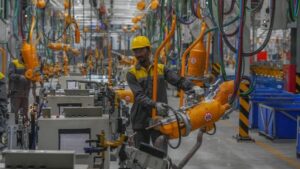
India has begun to recognize the strategic importance of rare earth recycling in strengthening its clean energy and manufacturing ecosystem. Although India holds about 6% of the world’s monazite reserves, large-scale extraction and refining remain limited due to environmental regulations and lack of processing technology (Atomic Minerals Directorate, 2024). To bridge this gap, India has turned toward urban mining and e-waste recovery as viable alternatives.
The Council of Scientific and Industrial Research (CSIR) and the Bhabha Atomic Research Centre (BARC) have jointly developed pilot projects for recovering neodymium, dysprosium, and terbium from discarded magnets, wind turbine motors, and hard disk drives. In 2024, CSIR launched India’s first E-waste Magnet Recovery Facility at Hyderabad, capable of recycling up to 100 tonnes of neodymium annually (CSIR, 2024). This initiative supports India’s “Mission REE Independence 2030,” aligned with the National Rare Earth Mission announced by the Ministry of Mines.
Additionally, Indian Rare Earths Limited (IREL) has partnered with private firms to explore coastal placer sands in Odisha and Kerala for monazite extraction while minimizing environmental impact. The National Aluminium Company (NALCO) and Defence Metallurgical Research Laboratory (DMRL) are experimenting with hybrid alloys and rare-earth-free magnets to reduce import dependency.
India’s strategy—combining recycling, technological innovation, and resource diplomacy—aims to transform it from a raw-material exporter into a global “rare earth manufacturing hub” by the early 2030s (Ministry of Mines, 2025).
Circular Economy and Employment Potential
The transition toward a Circular Economy not only ensures sustainable resource utilization but also opens avenues for new industries and employment. According to the International Labour Organization (ILO, 2024), global e-waste recycling could generate up to 70 million green jobs within the next decade, particularly in developing economies such as India, Indonesia, and South Africa.
Overall, the movement toward rare earth recycling represents far more than a technological innovation—it is a strategic and environmental imperative. Nevertheless, challenges remain: the environmental risks of deep-sea mining, the toxicity of e-waste, and the high cost of advanced recovery technologies. The path forward must therefore balance sustainability with innovation, emphasizing global cooperation for resource security and ecological stewardship.
8. The Future Direction and International Politics
As the world enters the second half of the twenty-first century, it stands firmly within the era of the Green Energy Transition. In nearly every field—electric vehicles, solar energy, wind turbines, battery technology, and quantum computing—the indispensability of rare earth elements is rising dramatically. According to the International Energy Agency (IEA, 2024), global demand for rare earths may increase three to sevenfold by 2040, with particular emphasis on neodymium, lithium, terbium, and praseodymium, all of which are essential for electric motors and renewable energy systems.
Consequently, rare earth elements have emerged as the strategic resources replacing oil. Just as the Middle East’s oil shaped twentieth-century geopolitics, rare earths have become the central axis of twenty-first-century power dynamics. China’s production and processing dominance, the United States’ technology-driven military-industrial complex, and the European Union’s Critical Raw Materials Act have together transformed this competition into a new kind of global rivalry (European Commission, 2024).
To reduce dependence on China, the United States, Japan, Australia, and India are strengthening collaboration through the Quad alliance and the Indo-Pacific Economic Framework (IPEF) to build resilient supply chains. The U.S. Department of Defense (2023) has provided strategic funding to Lynas Rare Earths in Australia to expand domestic refining capacities. India, meanwhile, has joined the Critical Minerals Partnership (CMP) to enhance cooperation in research and development on lithium, cobalt, and nickel.
Japan, since the 2011 Chinese export restrictions, has pursued recycling and deep-sea mineral exploration through the Japan Oil, Gas and Metals National Corporation (JOGMEC). The European Union, under its Raw Materials Alliance, has set ambitious goals—to increase domestic production to 10%, refining to 40%, and recycling to 25% by 2030 (European Commission, 2024).
The U.S. decision In 2025 to impose a 100% tariff on Chinese REE imports was a strategic measure designed to curb China’s geopolitical dominance. This event demonstrated that rare earths are no longer merely economic commodities; they are now weapons of diplomacy and defense. Although negotiations between Washington and Beijing later restored some balance, the crisis underscored a critical global lesson—the nation that controls rare earths will shape the trajectory of future technology and politics.
9. Conclusion: New Power, New Reality
International politics in the twenty-first century is undergoing a fundamental transformation—from oil-based power to metal-based power. Rare earth elements are no longer simple mineral resources; they form the core foundation of modern civilization’s energy, defense, and technological architecture. Just as petroleum once positioned the Middle East at the heart of global geopolitics, rare earths are now bringing East Asia, Africa, and South America into new strategic focus (World Bank, 2024).

China’s near-monopoly continues to destabilize the global economic equilibrium, driving the United States, Europe, Japan, and India to accelerate investments in alternative sources. India has already begun extracting thorium and neodymium from monazite sands in the coastal regions of Kerala, Odisha, Tamil Nadu, and Andhra Pradesh, under its National Rare Earth Mission and Critical Minerals Mission (2023). According to the Geological Survey of India (GSI, 2023), the nation holds an estimated 6.9 million tons of rare earth reserves.
However, technological limitations, low investment, and environmental constraints continue to be major obstacles. India’s refining capacity currently accounts for only 2–3% of China’s. Without international collaboration, this gap cannot be closed. Yet, if India—through partnerships in the Quad and IPEF—can acquire advanced refining technologies, South Asia could emerge as a new “Metal Corridor.”
The world now faces a new reality: rare earth elements are the geopolitical currency of the twenty-first century. Those who command these resources will determine the future of technology, defense, and even artificial intelligence (AI). The next global contest will therefore not be fought for oil, but for metals; not for weapons, but for processing hubs; not for empires, but for supply chains.