

India & World UpdatesHappeningsBreaking NewsFeature Story
Bridging policy to implementation: The twin tracks of climate action, written by Dr. Partha Jyoti Das
Feature On the occasion of the World Environment Day, June 5, 2026
// Dr. Partha Jyoti Das//
“Solutions to the climate crisis are within reach, but in order to capture them, we must take urgent action today across every level of society.” – Al Gore, former US Vice President, Renown climate activist, Winner of Nobel Peace Prize, 2007, and Founder and Chairman of the Climate Reality Project.
The official theme of the World Environment Day (WED) this year is “Inspired by Nature. For Climate. For Our Future”, while the Campaign Message is #NowForClimate. Perhaps nothing would have been more appropriate than this motif and messages at a moment when humanity as a global community and the planet earth as the only human habitat in the infinite Universe, is at a crossroads, not only due to increasing climatic risk, but also as a result of our failure to address the climate crisis to the desired extent.
The social and political conflicts all around the globe resulting in wars and other acts of violence also have worsened the climate and environmental catastrophes by causing huge volumes of additional greenhouse gases, widespread destruction and degradation of natural ecosystems, and toxic pollution of land, water and air.
This is the 8th occasion since the inception of the UN-led global event in 1974 that it has been observed on the issue of climate change. The earlier campaigns were: Global Warming; Global Warning (1989); Climate Change. Need for Global Partnership (1991); Melting Ice – a Hot Topic (2007); Kick the Habit – Towards A Low Carbon Economy (2008); Your Planet Needs You – Unite to Combat Climate Change (2009); Raise your voice, not the sea level (2014); and Beat Air Pollution (2019).
It is because of such intensive efforts of global agencies, national governments and local organizations and communities that the awareness about climate change – the causes, consequences, ways of mitigation and adaptation- have spread out to every nook and corner of the world.
So far reducing the concentration of greenhouse gases and adapting as best as possible to the adverse impacts of climate change are the two principal objectives so that adverse impact of climate change on water, food, health, nutrition, livelihood and environment can be minimized within stipulated timelines, both at international and national levels.
Multilateral and global agreements, protocols, and consensual decisions promoted by the United Nations and its organs and other agencies have paved the way for coordinated actions aimed at facilitating mitigation and adaptation through scientific research, technology development and transfer, and adequate funding for transition from a fossil-fuel based economy to an environmentally sustainable, socially just low carbon economy.
Globally, the formidable challenges that humanity is facing at present are unchecked greenhouse gas emissions, uncontrolled temperature rise, unprecedented extreme weather events leading to catastrophic flash floods and heat waves, loss of biodiversity, food, water and livelihood insecurity, growing inequality and inequity in economic development across the world and the economic and political hurdles stalling the global transition to renewable energy. It is confirmed now that the world is unable to limit the global warming below 1.5°C which was the primary target of the Paris Agreement.
In India, increasing severity of heat waves, droughts, floods and cyclones owing to atmospheric warming, extreme monsoon variability, large-scale glacial melting affecting the Himalayan river basins, and coastal erosion and salinization are some of the remarkable problems that people are suffering from.

The blistering summer heat with temperatures often raised to the range of 45 to 50 degree centigrade in Northwest, Central, Eastern and Southern regions, has become a seasonal disaster that is slowly gripping even a historically cooler and climatically pleasant region like northeast India. The annual loss and damage attributable to climate impact in macroeconomic terms is about 1.5% to 2% of its GDP (equivalent to ₹5.18 lakh crore to ₹6.91 lakh crore) out of which losses due extreme weather events amount to about ₹0.96 to ₹1.15 lakh crore annually.
The northeast Indian states have been found to be highly vulnerable to climate change in India and Assam, having over 60% of the most vulnerable districts in of the country, is one of the most affected states along with Mizoram and Arunachal Pradesh. The monsoon rainfall is decreasing significantly over several states of NE India including Assam, Meghalaya, Arunachal Pradesh, Mizoram, Manipur, Nagaland and Tripura since the beginning of the 1990s. Flood, riverbank erosion, landslides, hailstorms, forest fires, lightening, and land degradation due to river borne sedimentation are well known climate-induced disasters affecting the NE region while the magnitude, scale, frequency and adverse impact of such calamities are on the rise due to climate change.
Assam is slowly transforming from a traditional flood-prone state to an increasingly drought affected state thus creating a cycle of sequential climatic hazards throughout the year. The districts of Biswanath Chariali, Lakhimpur, Sonitpur, Bongaigaon, Bajali, Dhubri and Sivasagar have suffered more in terms of droughts in recent times. Assam has 23 districts that rank among the highest 50 flood risk-prone districts in India, whereas 8 out of the 50 most drought risk-prone districts of India also belong to Assam. Loss of biodiversity, growing threats to the survival of wildlife and their habitats, increasing insecurity of climate-dependent livelihoods are also affect ting the state in many perceptible ways.
India’s climate policy is strongly founded on the nine missions of the National Plan on Climate Change complemented by other national initiatives e.g., to promote renewable energy (National Green Hydrogen Mission, PM Surya Ghar: Muft Bijli Yojana), Nationally Determined Contributions (NDCs), Net Zero Pledge by 2070, clean mobility drives such as FAME Scheme (Faster Adoption and Manufacturing of Electric Vehicles) and CAFE Norms (Corporate Average Fuel Economy). India is also steering several global programmes like the International Solar Alliance (ISA), the Coalition for Disaster Resilient Infrastructure (CDRI), and the Global Bio-fuel Alliance (GBA).
The country aims to bring down the emissions intensity of its GDP by 47% by 2035 compared to 2005 levels; to achieve 60% cumulative electric power installed capacity from non-fossil fuel-based energy resources by 2035; to create an additional carbon sink of 3.5 to 4.0 billion tons of CO2 equivalent through expanded forest and tree cover by 2035.
The State Action Plans on Climate Change (SAPCCs) of the NE Indian states provide for a state level climatic scenario, assessment of climate impact and risks and elaborate action plans for mitigation and adaptation, which are useful knowledge resources for initiating actions on the ground. To make the state level plans reflect India’s current global commitments and national policies, all the NE Indian states must update their SAPCCs to conform to the NDC 3.0(2031-2035).
For Assam where we already have an updated SAPCC 2.0(2021-2030), several initiatives have been seen in the last three years that have indicated the state government’s seriousness in taking up climate actions to fulfil the country’s climate goals. Initiating green budgeting, climate tagging of state budget, mandatory allocation of funds for climate resilience and risk mitigation actions, preparing district level climate action plans, drafting a cooling action plan and an energy action plan for the state, piloting decentralized renewable energy projects, and strengthening urban climate monitoring are welcome steps.
Given the prevailing scenario presented above, this is high time we consider climate crisis as one of the most profound problems challenging humankind’s survival and sustenance. In the national context, how we tackle climate change is going to decide our economy, environment, and transition to a developed country by 2047.
Locally, what we do on ground in our communities, organisations and institutions through planned actions for effective mitigation and adaptation will determine how smartly we can deal with the impact, minimize climate risk and embark on a path of resilience for one and all. Climate action is the key to our survival and well-being, both at the global, regional, national and local contexts.
At Aaranyak, we have been addressing major climate issues pertinent to the NE region in general and Assam in particular through a holistic and institutionalized climate action agenda for over two decades. Studying climate variability and change, assessing climate and disaster risk, documenting adaptation practices of local communities, imparting awareness, education and training on climate issues, and policy advocacy are some of the activities that we regularly carry out though the ‘Water, Climate and Hazard Division. We have implemented projects on providing flood early warning, mitigating water scarcity, climate resilient agriculture through ground interventions.
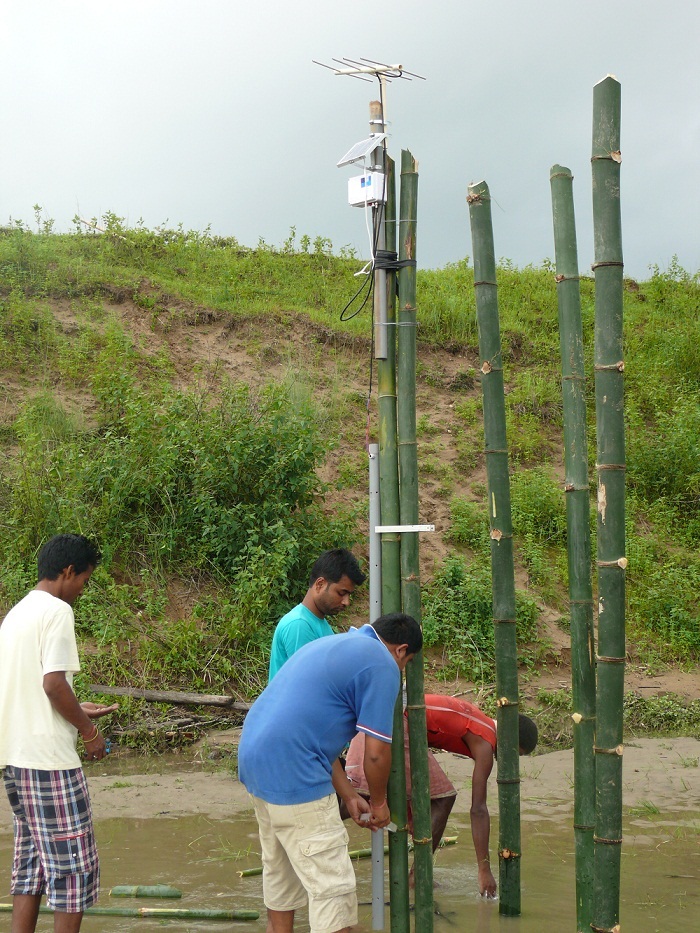
It is noteworthy that Aaranyak successfully led a project on ‘Community Based Flood Early Warning System’ carried out in Assam in collaboration with the International Centre for Integrated Mountain Development (ICIMOD), Kathmandu during 2010-2016. This project won the prestigious ‘Lighthouse Activity Award’ in 2014 from the United Nations Framework Convention on Climate Change (UNFCCC), Bonn, Germany (under Momentum for Change Programme). It was recognized as a best practice in climate change adaptation using Information and Communication Technology (ICT). This award was given to project in the COP-20 in Lima, Peru in December 2014.
…………….
Author Partha Jyoti Das, M. Phil, Ph.D. is the Director and Head, Water, Climate & Hazard Division, Aaranyak (A Scientific and Industrial Research Organisation of India).