

India & World UpdatesHappeningsBreaking NewsFeature Story
Netaji Beyond Politics: The Struggle to Preserve Historical Truth, written by Dr. Manoj Kumar Pal
Between Reverence, Distortion and Political Appropriation
//Dr. Manoj Kumar Pal//
Former Principal, Women’s College, Silchar
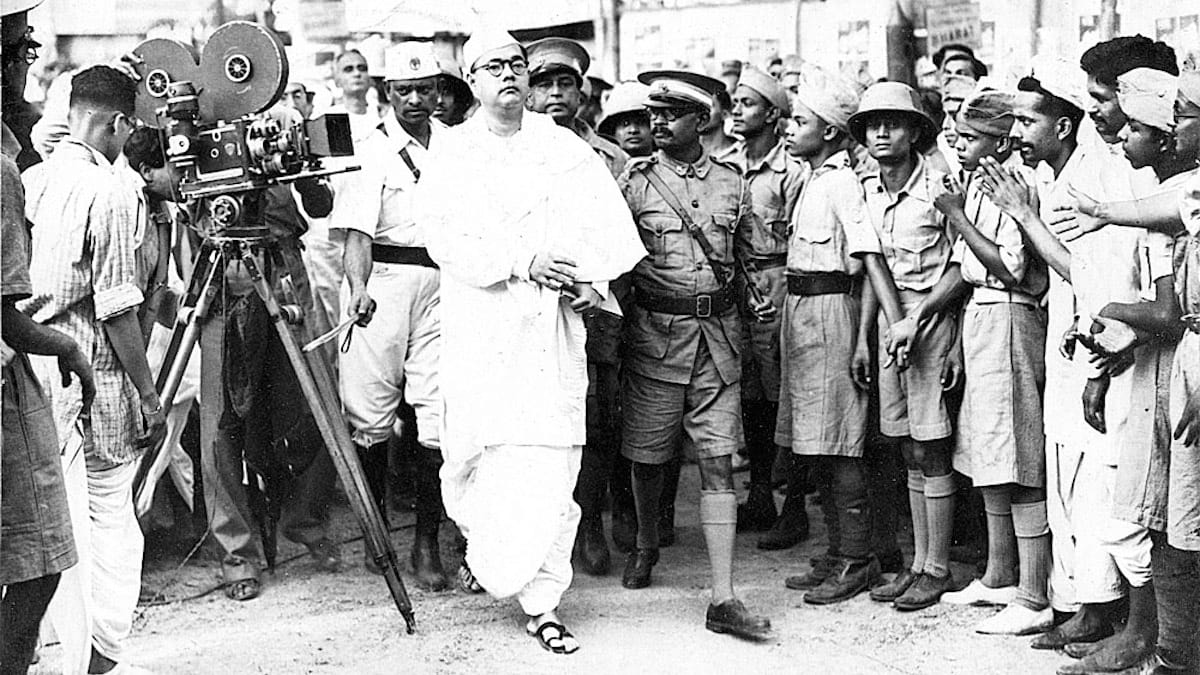
Netaji Subhas Chandra Bose is a name inseparably associated with one of the most courageous chapters in the history of India’s freedom struggle. He was not merely a freedom fighter. He was a political thinker, organiser, statesman and a leader who, in his uncompromising quest for independence, chose a path that went beyond the conventional political methods of his time.
There may be legitimate debates about his political strategies. Historians have extensively discussed his association with Germany, Italy and Japan during the Second World War, as well as his military and diplomatic strategies. Such debates are an essential part of serious historical scholarship. But criticism and insult are not the same thing. Questioning the decisions of a historical personality is perfectly legitimate in a democracy. Making ignorant or derogatory statements about his patriotism, sacrifice and historic contribution, however, reflects a disturbing disregard for history.
The recent remarks attributed to Rajya Sabha MP Nagendra Roy, popularly known as Ananta Maharaj, concerning Netaji and the Indian National Army (INA) have brought this question back into public debate. Reports of his comments regarding the character of the INA and Netaji’s leadership have generated considerable controversy. Significantly, senior BJP leader Tathagata Roy also publicly expressed his reservations about the remarks and warned of the possible political consequences of making controversial statements about a figure as deeply revered in Bengal as Netaji.
But is this the first such instance?
Certainly not.
Netaji’s legacy has repeatedly been subjected to political appropriation, historical misinterpretation and, at times, outright denigration. Sometimes he has been diminished; at other times, he has been excessively glorified in ways that do not conform to historical facts. Both tendencies are dangerous.
Sometimes Excessive Reverence, Sometimes Historical Distortion
Ahead of the 2024 Lok Sabha elections, BJP candidate Kangana Ranaut referred to Netaji Subhas Chandra Bose as the “first Prime Minister of India” in an interview. The remark generated considerable controversy. She subsequently referred to the establishment of the Azad Hind Government in Singapore in 1943 to explain her position.
Here lies an important historical distinction.
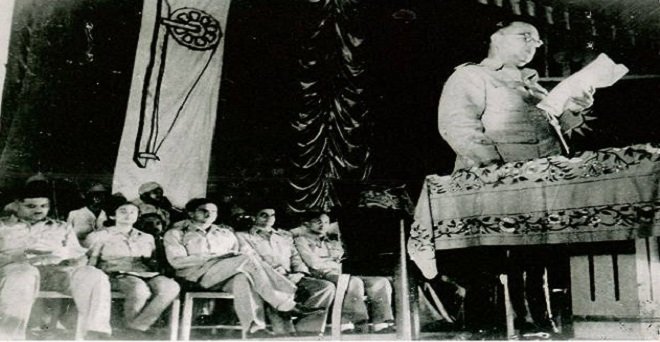
On 21 October 1943, Netaji established the Provisional Government of Azad Hind in Singapore and became its head, serving as its Prime Minister. But this was not the constitutional government of independent India that came into existence in 1947. It was a provisional government established with the objective of overthrowing British rule and achieving Indian independence.
Therefore, describing Netaji as the first Prime Minister of the Azad Hind Government is historically accurate. Calling him the first Prime Minister of independent India is not. Jawaharlal Nehru was the first Prime Minister of independent India.
Netaji’s grandnephew, Chandra Kumar Bose, also called for historical accuracy during the controversy. The larger lesson is important: there is no need to alter or exaggerate history to establish Netaji’s greatness.
To diminish Netaji is wrong; to make him artificially greater than history permits is equally wrong.
Netaji Does Not Need a Manufactured Greatness
Netaji’s stature is so immense that there is no need to turn him into something he was not.
He was the head of the Azad Hind Government. That is historically significant.
He organised an armed force dedicated to India’s independence. That is an extraordinary achievement.
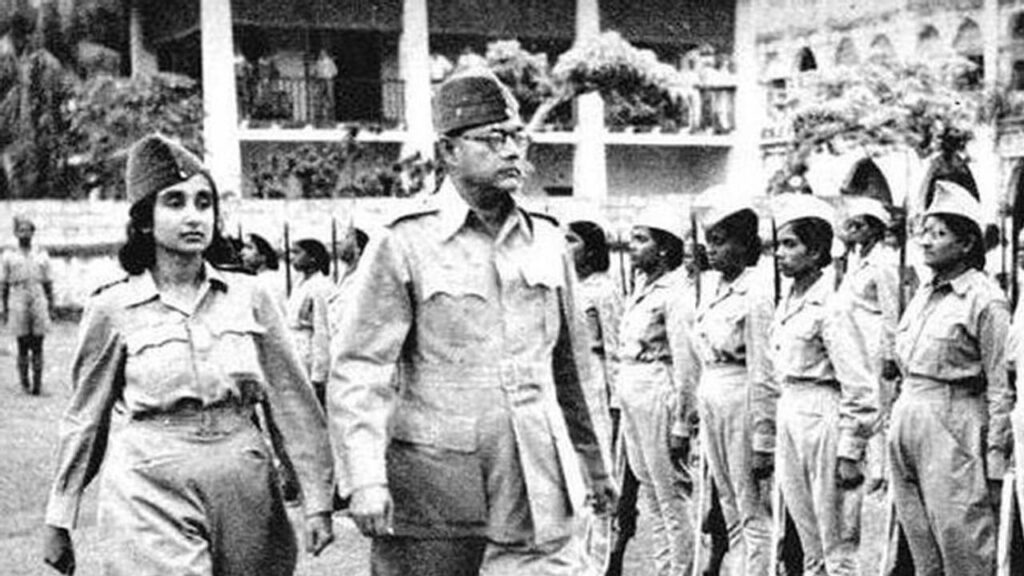
He inspired Indians with a renewed sense of confidence, sacrifice and resistance against British imperialism. That is an undeniable part of his legacy.
He sacrificed personal security and political comfort in pursuit of India’s freedom and sought international alliances in an extraordinarily difficult geopolitical environment.
His greatness lies in these historical facts. It does not require political embellishment.
The INA: A Defeated Army or a Victorious Political Symbol?
A recurring question in discussions about Netaji and the INA is whether the Indian National Army was militarily successful.
The historical answer is clear: the INA did not militarily defeat the British Empire and achieve India’s independence through force of arms.
But that is not where the history ends.
To understand the significance of the INA, one must look at India after 1945. The trials of INA officers at the Red Fort created an extraordinary wave of public emotion across India. The trials of Shah Nawaz Khan, Prem Kumar Sehgal and Gurbaksh Singh Dhillon became a powerful symbol of the nationalist struggle and generated widespread public reaction.
This is an important lesson in history.
An army may fail to achieve its immediate military objective and yet leave behind a profound political and psychological impact.
The significance of the INA cannot therefore be measured merely by battlefield victories and defeats. Its contribution to the changing political atmosphere in the final phase of British rule deserves serious historical consideration.
To dismiss the INA merely as a “failed military force” is therefore an inadequate reading of history.
Why Are Ananta Maharaj’s Remarks Important?
The recent controversy involving Ananta Maharaj must be viewed in this wider context.
When an ordinary individual makes an historically inaccurate statement, it may be dismissed as personal ignorance. But when a Member of Parliament makes such a statement concerning one of the most important figures in India’s freedom struggle, the matter assumes a different significance.
A Member of Parliament is not merely a private citizen. He is an elected representative.
Therefore, public representatives have a greater responsibility when speaking about historical events and national figures.
Criticism of Netaji’s political strategies is legitimate. Questions may be raised about his international alliances, military decisions or political philosophy. But such criticism must be based on facts, evidence and historical context.
The same responsibility applies when discussing the INA.
Netaji’s Greatest Strength: The Idea of India
One of the most remarkable aspects of Netaji’s political vision was his emphasis on a broad and inclusive Indian identity.
He sought to transcend differences of religion, language, region and community in the larger cause of Indian nationalism.
The INA reflected this vision. Men belonging to different religious and social communities served together in the struggle against British rule. The formation of the Rani of Jhansi Regiment under Captain Lakshmi Sahgal was another remarkable dimension of his movement and represented an important chapter in the history of women’s participation in India’s freedom struggle.
Netaji therefore cannot be understood merely as a military leader.
His political vision was much broader.
“Jai Hind” was not the slogan of any particular community. It represented an inclusive Indian national identity.
At a time when questions of religion, language, identity and regionalism continue to occupy the centre of political discourse, Netaji’s idea of an inclusive Indian nationalism remains deeply relevant.
Netaji and Gandhi: Political Conflict Without Personal Hatred
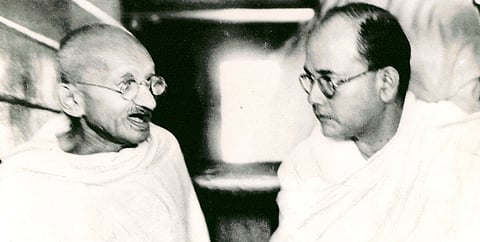
Any serious discussion of Netaji’s political career must acknowledge his differences with Mahatma Gandhi.
Netaji favoured a more radical and immediate approach to independence. He was prepared to consider armed struggle against British rule, whereas Gandhi placed his faith in mass mobilisation and non-violence.
Their political differences became particularly sharp during the Congress presidential crisis of 1939 and the events surrounding the Tripuri session.
But to portray their differences as simple personal hostility is an oversimplification of history.
Netaji’s reference to Gandhi as the “Father of the Nation” is itself an important indication of the complexity of their relationship.
The lesson is relevant even today:
Political disagreement does not necessarily mean personal disrespect.
Netaji and Nehru: Rivalry or Historical Complexity?
Another recurring theme in contemporary political discourse is the relationship between Netaji and Jawaharlal Nehru.
Sometimes the two are presented as absolute political enemies and the post-independence period is portrayed as an era in which Netaji’s legacy was deliberately erased.
History is more complex than that.
Netaji and Nehru certainly differed ideologically and politically. They had different approaches to the Congress, the freedom struggle and the future of India.
But both were major figures in India’s freedom movement.
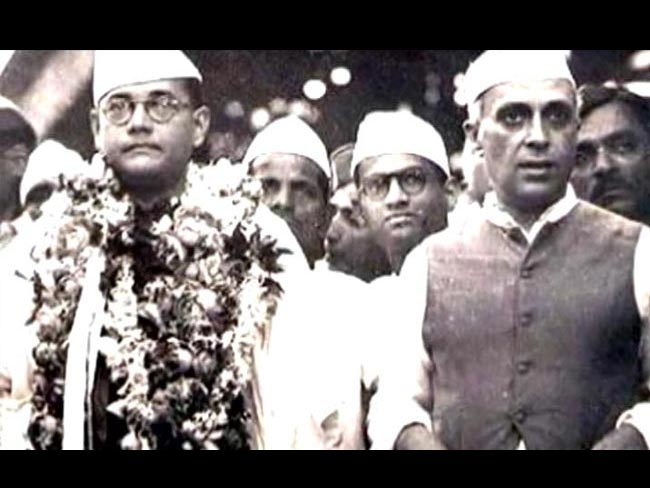
Nehru became the first Prime Minister of independent India. Netaji became the head of the Provisional Government of Azad Hind in 1943 and served as its Prime Minister.
There is no contradiction between these two historical facts.
The contradiction emerges only when one fact is politically manipulated to erase another.
The Dangerous Culture of Political Statements
The current controversy surrounding Netaji should not be treated as an isolated incident.
Indian politics has repeatedly witnessed politically motivated or historically inaccurate statements about major national figures. Mahatma Gandhi, Jawaharlal Nehru, Subhas Chandra Bose and Rabindranath Tagore have all, at different times, become targets of political rhetoric.
There is nothing wrong with criticising Gandhi’s political methods, Nehru’s policies or Netaji’s strategic decisions.
But such criticism must be based on evidence and reason.
History should not be distorted merely to win applause at a political rally.
Nor should historical personalities be reduced to weapons for attacking political opponents.
No political party can claim exclusive ownership of Netaji’s legacy.
The Lesson from the Kangana Ranaut Controversy
The Kangana Ranaut episode provides another important lesson.
Her statement did not belittle Netaji; rather, it attempted to elevate him by overlooking an important historical distinction. The controversy demonstrated how political rhetoric can blur the boundaries between historical fact and political symbolism.
The lesson is simple:
If we truly respect Netaji, we must first respect the historical truth about him.
There is no need to turn him into a historical myth.
His actual achievements are extraordinary enough.
What About Ananta Maharaj’s Remarks?
The controversy surrounding Ananta Maharaj is different.
Here the criticism has been that remarks were made which diminished the role of Netaji and the INA. If a public representative interprets an important chapter of the freedom struggle in a manner that contradicts established historical understanding, the political establishment has a responsibility to respond.
Should the political party concerned seek an explanation?
Or should political calculations determine silence?
These questions are not relevant only to the BJP.
They concern every political party in India.
Because history belongs to the nation, not to any political organisation.
Is Political Protest Enough?
West Bengal Chief Minister Mamata Banerjee has criticised the BJP over the controversy and described the alleged insult to Netaji as an insult to the nation, according to media reports.
Such political protest is understandable.
But another question remains:
Should Netaji merely become a weapon for attacking political opponents?
If political parties genuinely respect him, they should also engage seriously with his ideas, his inclusive nationalism, his political philosophy and his vision of India.
Condemning an opponent is not, by itself, a tribute to Netaji.
The Politics of Netaji’s Memory
There are two contradictory tendencies in contemporary Indian politics.
One is to exaggerate Netaji.
The other is to diminish Netaji.
The first turns history into mythology.
The second makes history a victim of political hostility.
Both are dangerous.
Netaji must be returned to the realm of history.
We must study his achievements as well as his limitations, his military campaigns as well as his international relationships, his political philosophy as well as his ideas about the state and economy.
Only then can we understand him in his entirety.
The Business of Memory
The phrase “business of memory” may sound harsh, but contemporary political reality often demands uncomfortable words.
During elections, national icons suddenly become politically visible. Their photographs appear on posters, their birthdays become political events, their slogans are repeated and their statues are garlanded.
But how often do we read their writings throughout the year?
How often do political parties seriously discuss their ideas?
How much do we teach younger generations about the complexity of their political thought?
This raises an uncomfortable question:
Is this genuine remembrance—or political exploitation of memory?
Who Loves Netaji More?
Contemporary politics sometimes produces a strange competition: who loves Netaji more?
One party claims his legacy.
Another accuses its opponent of forgetting him.
One uses his photograph.
Another invokes his slogan.
Yet Netaji’s legacy is far greater than an election slogan.
His legacy is courage, discipline, organisation, sacrifice, self-respect and the determination to devote everything to the cause of freedom.
We should therefore not merely conduct politics around Netaji.
We should engage in politics inspired by the values he represented.
Netaji Belongs to the Nation
No political party can claim exclusive ownership of Netaji.
He is not a vote bank.
He is a national historical figure.
His political strategies can be debated. His international alliances can be questioned. His decisions can be critically examined.
But historical facts must be respected.
If a political leader makes a derogatory statement about him, the response should rise above party lines.
Otherwise, we risk creating a political culture in which the dignity of national icons becomes negotiable according to electoral convenience.
The Larger Question Is Not Merely About Netaji
At the deepest level, this debate is not only about Netaji.
It is about our political culture.
Do we really know our history?
Or do we merely use history?
Do we want to understand national leaders in all their complexity—their achievements, limitations, disagreements and ideas?
Or do we reduce them to a few quotations, photographs and slogans that suit our political narratives?
To belittle Netaji is wrong.
To invent a greater Netaji than history permits is also wrong.
To make him the property of a political party is wrong.
To turn him into an electoral poster is equally wrong.
True respect for Netaji begins where political convenience ends and responsibility towards history begins.
What India needs today is not another competition over who respects Netaji more, but an honest historical re-reading of his life and legacy.
History may be distorted in speeches, posters, social media and election campaigns. But historical truth cannot be permanently rewritten by political rhetoric.
It is time to take Netaji out of the narrow confines of partisan politics and restore him to the larger pedestal of history.
He belongs to no single party.
He belongs not merely to Bengal.
He belongs to India.
And the first and final condition of truly honouring Netaji is simple:
Let history remain true.