
Barak UpdatesHappeningsBreaking NewsFeature Story
The Saga of a Dimasa village (Part 4), written by Sanjib Deblaskar
//Sanjib Deblaskar //
4.
I must also reserve a special place in the recollections for the eminent historian Nalinindra Kumar Barman and his family. His daughter Malabika, a year junior to me in school, possessed exceptional musical talent. She frequently came to our house for rehearsals with us including my sisters, yet she invariably kept a few songs in reserve, unveiling them only at the programs like Rabindra Jayanti, and other cultural events, much to our surprise and delight. Her rendition of hits of Lata Mangeskar like the one of Salil Choudhury ‘Prajapati! Prajapati ! pakhna melo’ still haunts our memory. She was an artist Silchar. Rest I forget, let me add some lines on Nani Gopal Barman (later on shifted to Harinagar, an educator, socio-politico activist) whose rendition of a Dimasa bhajan could be heard only the other day in the morning recitals of All India Radio, Silchar—‘bara Ranachandi mai’.
In the mid sixties modern songs could be heard only on the radio. The broadcasters, however, followed their own schedules and preferences, not the wishes of eager listeners in the villages across Jatinga. Getting the latest songs by heart and reproducing the lyrics accurately was no easy task. We had neither a gramophone nor a record player, which made the challenge even greater. Yet, despite these limitations, the minstrels of Bijaypur remained our worthy rivals. Across the Jatinga, an unspoken competition flourished between their singers and ours, each side striving to master and perform the latest songs with greater skill and fidelity.
5.
To return to Nalinindrababu—he would often visit our father for long conversations. During those visits, he invariably enquired affectionately of our elder brother, Sajalkanti. It was because one of his daughters lived with her husband sharing the campus life with him in Namrup HFC quarters. He was a indeed a striking figure: clad in a white dhoti, wearing thick, powerful spectacles, and sporting a dark moustache. During his years as a teacher in Haflong, he had many memorable experiences, one of which he recounted with particular pleasure.
In 1947, on the occasion of India’s Independence, this gentle and unassuming schoolmaster invited the European Sub-Divisional Officer of Haflong, along with railway staffs to attend the celebration at his school. Nalinindra Kumar remembered the officer’s name as Mr. Parry John—or something very close to that. Under his guidance, the national anthem was sung as the tri-colour was hoisted. In a gesture that left a deep impression on those present, the headmaster greeted the departing colonial administrators with the words: “You have so long been our boss, henceforth you be our friends.”
The dignity and grace of that moment remained vivid in Nalinindra Kumar’s memory for many years thereafter. It was one of those rare occasions when the end of an empire and the birth of a nation were marked not by bitterness, but by mutual respect and goodwill.
To come to certain personal matters of the teacher, a rather sad matter still lingers. Nalinindrababu lived a long life, but not his children. He had to witness the death of one of his daughters, Bharatidi. The others, of course, survived him, but scarcely had the father departed than one after another his children–Tribenidi, Alokadi, Bhaskarda and Lakshadharda—followed him within a comparatively short span of time. Today, of all the children of the historian only the youngest one remains, a retired principal of Haflong Government Girls’ HS School carrying the burden and privilege of preserving the memory of an unsung yet remarkable father. There is a poignant irony in this personal account of Nalinindra Kumar, a man devoted so much of his life to recording the lives, struggles and memories of others has faded from public remembrance, with only a single surviving child left to keep alive the story of the man and his time. May God grant her many more years of happiness and good health. In the 1970s, she narrowly escaped when a boat capsized, an accident in which one of her fellow students, Swastika lost her life.
The old man, of course, left behind a number of grandchildren. Among them, Manali chose the path of scholarship and today serves as a Professor of Linguistics at the prestigious Assam University. Several academic works bear her name, including an ‘Illustrative primer’ on the Dimasa language, and a number of important contributions to the compilations, “Dimasa Studies”, which she herself had edited too. But what of another grand daughter? That story remains to be told, and I shall turn to it presently.
Nalinindra Kumar Barman was a historian of considerable distinction who was invited by the Doyan of the historians in Assam, Professor HK Barpujari to deliver lecture on Dimas history and culture in the University of Gauhati. He is best known for the book The Queens of Cachar and the History of Kachahari, a copy of which he presented to my father. I feel proud in telling that the book, however, included an article that have first published in magazine of Raja School, Muktarhara, in 1968 which incidentally bears the name of the present author as Editor, although the actual editorial responsibility were carried out by teacher-in-charge Subrata Dey.
After completing my masters from Gauhati University, I had the occasion of visiting him several times, and when my interest in the regional history deepened in the early 1990s at the behest of Professor JB Bhattacharjee, Dr. Sujit Choudhury, and my senior scholar-friend Dr. Amalendu Bhattacharjee, those visits became more frequent. I benefited immensely from my conversations with him. Whenever I showed him my attempts at writing on local history, he responded with genuine encouragement. On one occasion, after reading some of my papers, the old historian was so pleased that he wrote to me with exaggerated fervor, remarking that Assam University would do well to honor its author with a Ph.D. Alas! he did not live long enough to persuade the Vice-Chancellor of the merits of his affectionate protégé. ((Nalinindra Kumar breathed his last in July 7, 1996 )
In an unpublished manuscript in my possession, Nalinindra Kumar wrote at length about his school days, his companions and senior friends such as Barada Chakrabarty and others, and his experiences during the great flood of 1336 Bangla (1929). He also recalled the Swadeshi movement, which led to the imprisonment of his dear senior friend Jatindra Mohan Deblaskar and the imposition of fines on his family and several other villagers (spectre of which, however, figured in two of my Bengali novels, “Shasti-tat-purush-nama” (‘The saga of sixth generation’, and also in “Alar Manush” (The Enlightened).
Among the most valuable portions of the manuscript is his journey during the tempestuous days prior to independence, to Shillong, to met Gopinath Bordoloi to impress upon him the need to ensure that Cachar remained within Indian territory should the partition of the country prove unavoidable.
Equally fascinating are the intimate glimpses of domestic life that the manuscript preserves. Nalinindra Kumar wrote with great pride about his mother’s culinary skills, many of which he himself had mastered. With characteristic warmth and humor, he also recorded his impressions of his daughter, Tribeni, remarking that she had inherited a large head and a prominent nose, but not her grandmother’s intelligence. I do not know how far the father was correct in assessing his daughter, but the grand-daughter in her linage, Ritu (Thaosen) is now a successful professor of history in the prestigious Cotton University, Guwahati.
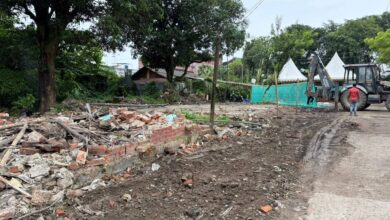
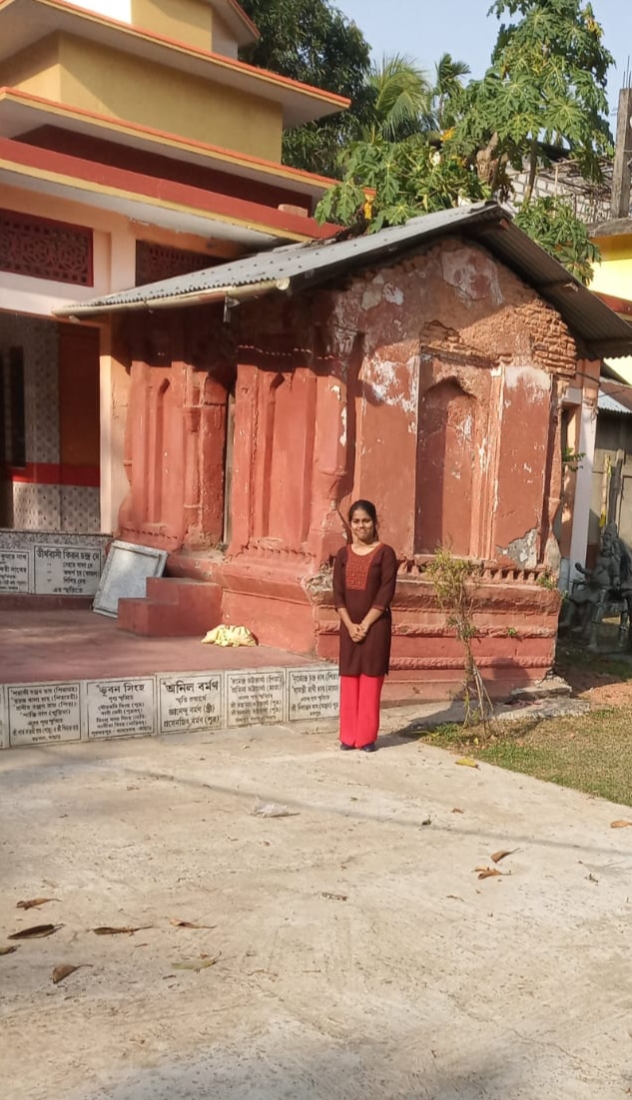
(Photo: Remains of Nimata temple of 19th century)