
Barak UpdatesAnalyticsFeature Story
Atal Bihari Vajpayee : A Visionary, A Poet and A Great Statesman, written by Prof. Rajive Mohan Pant Vice Chancellor, Assam University
A Special Tribute on the Death Anniversary
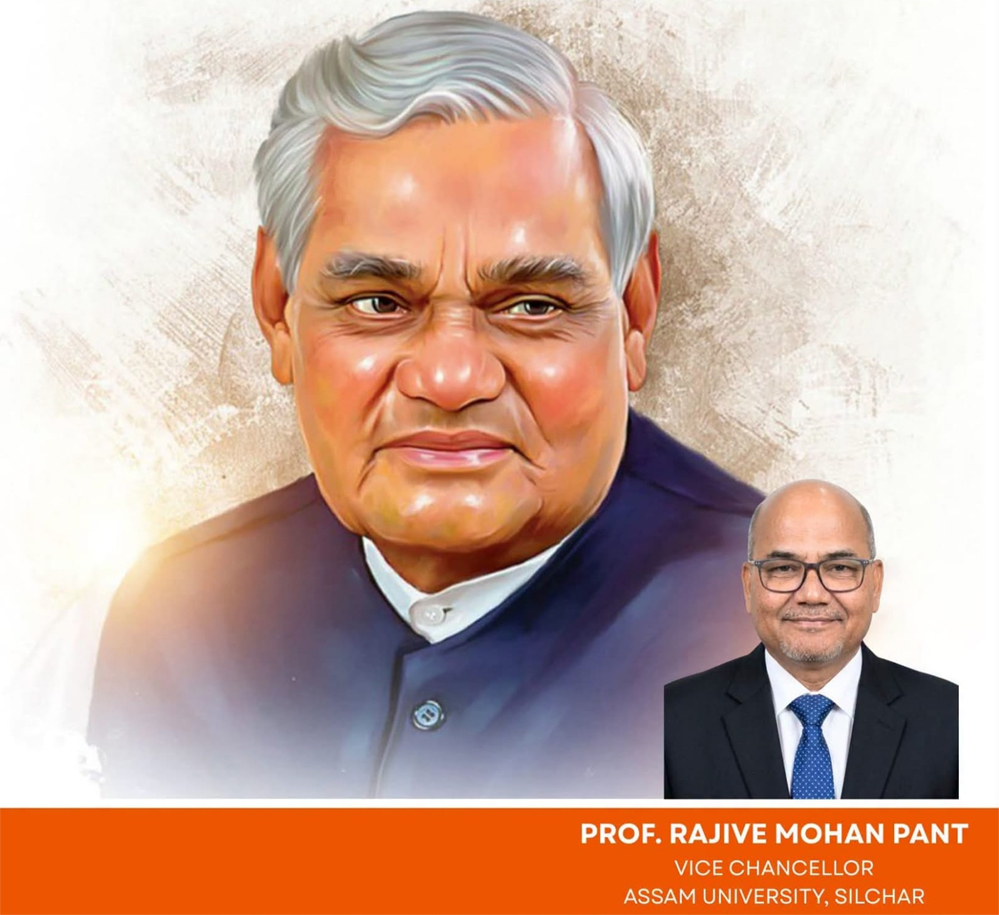
Silchar, August 16 : ‘He is a very humble man and never puts on airs. He was humble enough to come to my simple home just to make a request to me to accept the ambassadorship in the USA. That humility was unparalleled and touched me very deeply’, reminisced Nani Palkiwala.
Atal ji himself admits, “Main sapno ka suadagar nahin hoon. Mere paanv zamin par hain.” (I am not a dream merchant. My feet are firmly on the ground) In one of his popular pieces of poetry he writes, ‘God don’t take me to such heights which isolate me from my fellow human beings.’ A common man’s friend, simple and suave Atal ji was born on December 25, 1924 in Gwalior. A great orator since his childhood, he was destined to become the Prime Minister of the country. Pandit Jawahar Lal Nehru had predicted during his early days that this man would be India’s Prime Minister one day. Pt. Nehru’s prediction became a reality in the year 1996, though it was short-lived. However, in the year 1988, he became Prime Minister for the second time, not for just 13 days this time but to give shape to India’s march into the 21st century. His political career spans over seven decades. ‘He may be the patriarch of the saffron party, but his politics has never been monochromatic’, says renowned journalist Prabhu Chawla. And his life reflects the colours that have typical Indian shades.
Atal, a school boy from Gwalior goes to Lucknow to participate in a national level debate competition along with one of his classmates who joined him at Charbagh Railway Station in Lucknow. His friend revealed at the last minute that he has prepared his talk ‘for the motion’. Atal had also prepared his talk ‘for the motion’ but considering his friend’s helplessness, Atal agreed to speak ‘against the motion’. And he stood first in this fiercely fought competition. That was for the first time his oratory skills were seen by the world. Best parliamentarian of free India was in the making.
He charmed India’s masses with his unique poetic flavour. Known for not attacking even his direct opponents, his satires on faulty systems are good enough to keep defaulters on the righteous path. A great patriot, who in the time of need always rose above party politics. Atal ji was the first person who stood firmly behind Mrs. Indira Gandhi during the Indo-Pak War in 1971 and appreciated the bold decisions of the then Prime Minister. His patriotism was reflected before the whole world when he addressed the UN General Assembly in Hindi for the first time and became the first Indian to deliver a talk in Hindi at an international platform giving a new identity to this great nation.
This not only left a deep impact on the Indian mindset that was enslaved for centuries but also presented a new image of a confident India before the world. When Pakistan was sharpening its teeth with nuclear weapons, it was under his leadership that Pokran-II took place, leaving the whole world dazed and forced the CIA and ISI to scratch their heads in utter disbelief. A bold gamble, it was to create a deterrent for a threat coming from our next-door neighbour. Jingoism was never his ideology; however, peace is not possible if one does not have strength.
His poem truly reflected his fighting attitude when he says ‘Haar Nahi Maanunga, Raar Nayee Thanunga’ (I will not accept defeat and will fight afresh’) and he proved this, time and again. He believed in peaceful co-existence for all the neighbours. He traveled to Lahore by bus to ensure better relations between the colonial cousins and when betrayed, ‘Kargil crush’ was witnessed by the world and once again Pakistan was made to bite the dust. Every Indian saw his firmness on TV during the Agra Summit when the Pakistani General Pervez Musharraf left the Summit rather unceremoniously. But Atal remained Atal (firm) whenever it came to matters related to country’s interest. When someone in Pakistan commented ‘Pakistan is incomplete without Kashmir’, Atal ji was prompt in replying that ‘we feel India is incomplete without Pakistan’. Polite Atal ji was known to convey the strongest message in the politest manner in his own satirical style, leaving opponent speechless.
Despite being a staunch ‘Hindu’, he never shirked from taking a stand against his own party also in the larger interest of the country and always preferred ‘Rashtra-Dharm’ over ‘Raj-Dharma’. He remained a true secular leader unaffected despite continuous attacks on him by his several political detractors.
A great visionary, he bailed India’s economy out of a deep economic crisis. Indian economy was in the grip of the worst-ever crisis of depleted foreign exchange reserves when Atal ji took over as Prime Minister and when he stepped out, India had a comfortable stock of foreign exchange reserves. Policies of liberalisation, globalisation and privatisation that was pursued by his government led India to the path of progress and India became an economic power to reckon with at the international level. During his tenure as the Prime Minister of India, he achieved so much that no other leader could ever do. ‘Golden Quadrangle’, his dream project paved the way for India’s strides in the quest of becoming the ‘Golden Bird’ again.
India’s foreign policy, economic and industrial growth and India’s reputation as a world leader received a shot in the arm under his leadership. ‘Power makes a man corrupt and absolute power makes him absolutely corrupt’, Mao’s universal truth failed in case of Vajpayee ji. He had seen all heights. He had been the most powerful person of India’s politics, yet all this could not adulterate his humility, his humane personality. Power could not overpower the poet in him.
A nature lover, he always found great solace in the lap of Mother Nature. That is what kept him away from the polluted materialistic world of Indian politics. His Manali sojourn every year did not only provide him a refreshing break out of his busy political and public engagements but also developed the creativity that is seen in his poems.
A statesman who served the country for more than seven decades, a visionary leader and a great parliamentarian who is unparalleled in his dedication for the country and above all a great human being who is loved by one and all despite ideological differences, Atal ji remained the most popular personality that Indian politics has seen since Independence.
A spotless leader throughout his career, he is a role model not just for the people of his time but also an inspiration for future generations. ‘Ajatu Shatru’ of Indian politics will remain in the minds of people of India and will continue to inspire all Indians. He represented the value system that India has inherited from her glorious past and applied this with a futuristic vision for India’s development. He is no longer with us but the path he has shown will continue to guide the generations. He will always be remembered as the man who ushered India into the 21st century.