
India & World UpdatesHappeningsBreaking NewsFeature Story
Aneet Padda’s Meenu Rawat in Hunkkaar: A Performance that roars without raising its voice, written by Shanku Sharma
//Shanku Sharma//
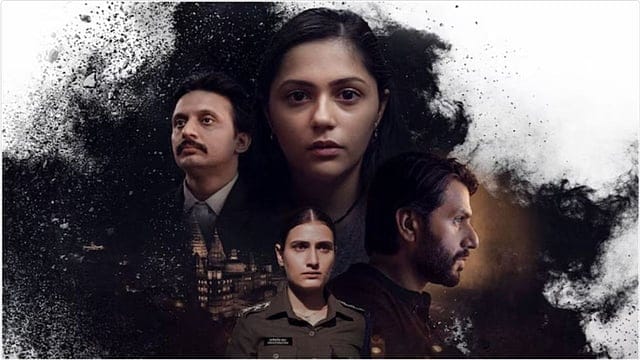
In the six-episode JioHotstar socio-thriller Hunkkaar: The Roar, Aneet Padda delivers a performance of remarkable restraint and emotional precision as 17-year-old Meenu Rawat, a schoolgirl who accuses a powerful godman of sexual assault and then endures the cascading cruelty of disbelief, public scrutiny, and institutional indifference. Shot before her breakout in Saiyaara (when she was around 19–20), the role now arrives as a powerful counterpoint to that romantic stardom—revealing an actor capable of carrying a story’s moral and emotional weight with quiet intensity rather than theatrical excess.
Set in the fictional town of Kharganj, Madhya Pradesh, the series follows Meenu after she walks into a police station with her parents and names Sunil “Baap Ji” Chakosi (the brilliant Raghubir Yadav). What begins as a complaint quickly expands into a battle against faith, influence, media, and a community that prefers the comfort of denial. Padda anchors this slow-burn examination of shame, power, and survival. She refuses to turn Meenu into a pure symbol or a perpetual spectacle of suffering. Instead, she plays a teenager who still wants ordinary things—normalcy, privacy, a life not reduced to one incident—even as those around her insist on defining her by it.
The strength of the performance lies in what Padda withholds. Trauma is shown through silence, hesitation, guarded body language, and the shifting focus of her eyes. In quieter family scenes, belief itself becomes a wound; her isolation deepens not through big speeches but through the accumulation of small refusals and exhausted glances. Reviewers have noted how she keeps Meenu recognisably young and complicated—frightened, angry, sometimes inconsistent—rather than polishing her into an idealized survivor. The character’s journey from someone still measuring herself against others’ judgments to a person determined to claim her own truth feels earned because Padda never forces the transformation.
That control reaches its peak in the courtroom monologue of the final episode. Forced to recount the assault yet again while the accused continues to command reverence, Meenu’s frustration, rage, fear, shame, and defiance surface in overlapping waves, sometimes within the same sentence. Padda modulates voice and pitch with surgical precision; the scene has been widely called one of the year’s strongest, a rare alignment of writing, direction, and performance that briefly turns the series into exactly what its title promises. It is the moment the character’s vulnerability becomes liberation rather than further burden.
Directors Nitya Mehra and Karan D. Kapadia (who had worked with Padda earlier on Big Girls Don’t Cry and a short film) chose her for the rawness and emotional intelligence she already displayed. They describe an organic, method-leaning process: she prepares thoroughly, settles into the character’s headspace, and often nails key moments in early takes. Her eyes, they note, do much of the heavy lifting. Padda herself has spoken of the role’s sensitivity and the strange fit of her own youth with Meenu’s. Auditioning at 19 for a 17-year-old who could barely articulate what had happened to her felt seamless; the surrounding perspectives in the script were so strong that she sometimes questioned her own certainty—mirroring the character’s disorientation.
The series has its structural unevenness—some critics find the pacing diffuse or certain plot developments convenient—but Padda’s work remains the consistent emotional core. Supporting turns by Fatima Sana Shaikh (as the investigating officer), Raghubir Yadav (a masterclass in soft-spoken menace), and others create a credible social pressure cooker around her. Yet it is Meenu’s interior life that lingers: the exhaustion of having to prove pain repeatedly, the refusal to let the crime define every remaining moment of her existence, and the hard-won decision to speak anyway.
In an industry quick to typecast young actors after a romantic success, Hunkkaar functions as a timely reminder of Padda’s range. She does not overplay intensity; she trusts the audience to meet her in the silences. The result is a performance that feels lived-in rather than performed—one that understands trauma as ongoing, justice as incomplete, and courage as the first note of a voice long suppressed. That is the real roar of Hunkkaar.