

Barak UpdatesHappeningsBreaking News
A note on the Badarpur fort by Sanjib Deblaskar
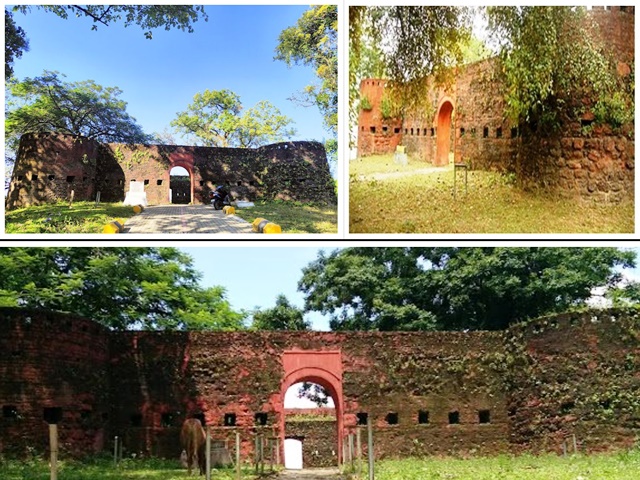
//Sanjib Deblaskar//
The Government of Assam cites the Department of Archaeology and states that Badarpur Fort belongs to the late medieval period and was constructed during the reign of the Cachari King Govinda Chandra. This attribution raises an important historical question. A fort exhibiting unmistakable Mughal military architectural features can hardly be dated to the brief and politically turbulent reign of Govinda Chandra (1817–1830).
At the outset, it should be clarified that the present author has not recently visited the fort site and has therefore not examined any inscriptions or archaeological evidence that may presently exist there. The observations made below are based on available historical sources and are intended as a contribution to further research.
The Mughal connection with Badarpur is traceable at much earlier time than the emergence of Dimasa polity in this region. We must recount it that during the reign of Emperor Akbar (1556 to 1605), Sylhet was incorporated into the Sube Bengla as one of its sirkars under a faujdar. A network of thanas was established under the Mughal administration, and it was during the period Badarpur emerged as an important frontier military outpost with a fortified garah. During Raja Todar Mal’s revenue settlement, Sylhet was divided into eight mahals, (of which Pratapgarh, now in Karimganj district, was one).
Subsequently, during the reign of Emperor Jahangir (1605-1627), two Mughal expeditions (1612) were launched against the Dimasa kingdom with its capital at Maibang. Following their defeat at Asuritikar and Pratapgarh, the Dimasa ruler agreed to pay forty elephants and one lakh rupees to the Mughal court, five elephants and twenty thousand rupees to the Subedar of Bengal, and two elephants together with twenty thousand rupees to the thanedar of Bundashil, near Badarpur, as najarana in connection with the peace settlement. These developments underline the strategic importance of the Badarpur frontier under Mughal administration long before Govinda Chandra ascended the throne.
Govinda Chandra came to the Khaspur throne only in 1817. His reign was marked by political instability, opposition from sections of the Hinduised Dimasa nobility and Bengali courtiers over his relationship with Induprava, the widow of Maharaja Krishnachandra (whom he married much against the public consenstious), coupled with repeated Burmese and Manipuri incursions, and severe financial and military constraints. He was eventually compelled to abandon his capital at Khaspur, take refuge for a time in the wilderness of the Maibang hills, subsequently seek shelter in Sylhet, and finally on being back to Cachar establish a humble temporary capital at Haritikar (where he was assassinated in 1830, near Badarpur. Remembered more for his literary and artistic pursuits, including devotional compositions and a Vaishnavite lyrical opera (in Bengali), he was hardly in a position to undertake the construction of a major frontier fort in the established Mughal military architectural tradition.
This assessment, however, does not undermine the legitimacy of the Dimasa community’s desire to associate the fort with Maharaja Govinda Chandra. There is reason to believe that the treaty acknowledging British suzerainty in 1824 was concluded there. That historical association has been recognised by an Hon’ble Minister of the Government of Assam and has also been rather emphatically, and with evident pride, endorsed by a member in the assembly representing the plains of Cachar, whether or not he was fully aware of the historical background underlying the issue.
It is also worth recalling that after the matrimonial alliance between the Koch and Dimasa royal houses and the establishment of Dimasa reign at Khaspur at the termination of Koch rule, only two rulers governed from Khaspur, Maharaja Krishnachandra (d. 1817) and Maharaja Govinda Chandra (d. 1830). In view of the political circumstances of this brief period, there appears to be little historical basis for attributing the construction of a strategically conceived Mughal-style frontier fort to the Khaspur court.
These observations offered solely in the spirit of academic inquiry and for our future guidance, and for assessment of the historical reality with reason and with no politicking.
(A more detailed discussion of the issue is available in the author’s Barak Upatyakar Itihas O Samaj, Paunami Prakashan, Agartala, 2011, pp. 27–28.)