

India & World UpdatesHappeningsBreaking NewsFeature Story
When Skills Out-Earn Degrees: Is India Creating a Crisis of Education and Income? Written by Dr. Manoj Kumar Paul

✍️ Dr. Manoj Kumar Paul
For generations, Indian families followed a simple formula for their children’s future:
Study hard → obtain a degree → get a respectable job → earn a stable income → build a secure life.
That social contract is now under increasing pressure.
A young person may spend three years completing a bachelor’s degree, another two years pursuing a master’s degree, and sometimes several more years preparing for competitive examinations—only to enter the labour market at a salary lower than the monthly income of a skilled electrician, plumber, driver, technician or small trader.
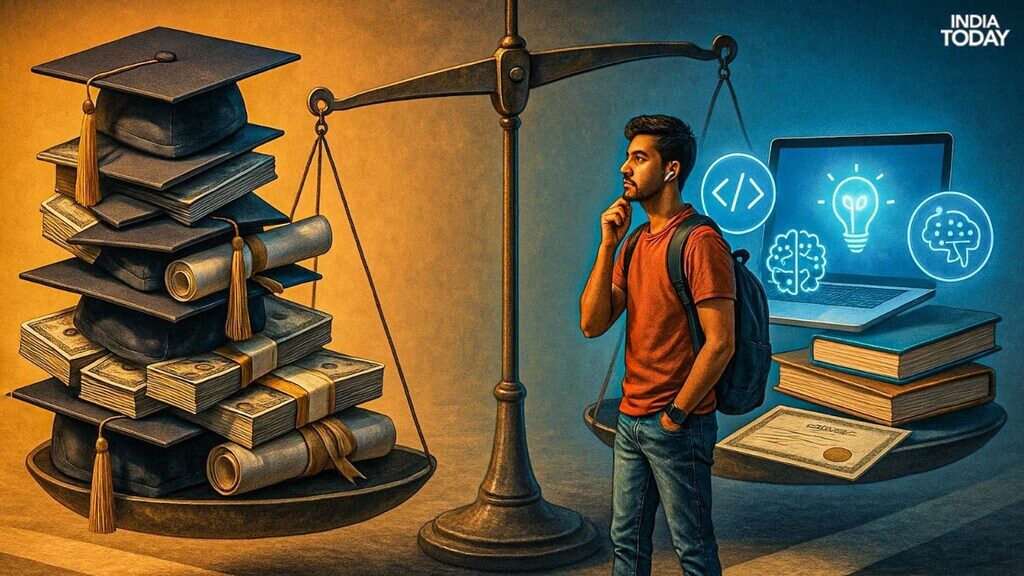
The question is not whether skilled workers deserve good incomes. They absolutely do. The deeper question is:
If years of higher education, tuition fees and opportunity costs do not translate into substantially better employment opportunities, why should the next generation remain convinced that a degree is worth pursuing?
That is the education-income mismatch India cannot afford to ignore.
The provocative picture circulating on social media
The graphic accompanying this article claims that India is heading towards a “degree collapse” and that 80% of colleges could shut down within ten years. That specific figure has no authoritative evidence behind it and should not be treated as established fact.
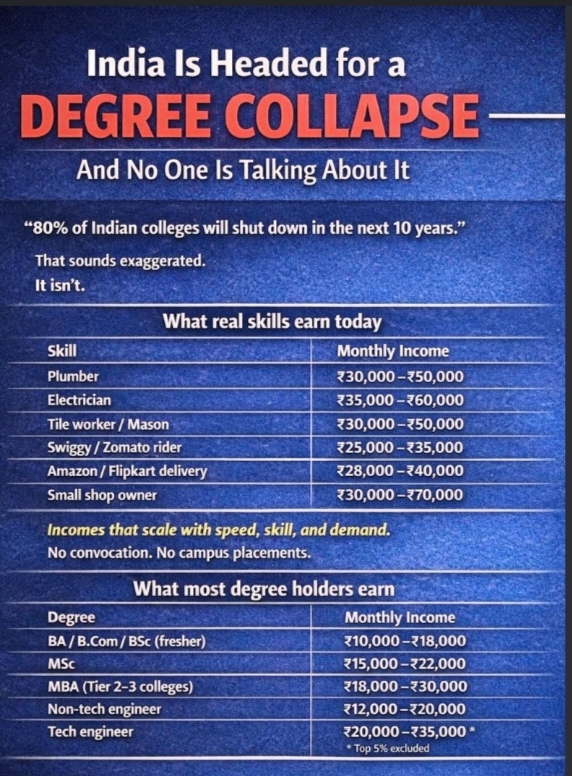
But the underlying concern is real.
India is producing more educated young people while the economy struggles to create enough good-quality, skill-intensive jobs to absorb them.
The International Labour Organization’s India Employment Report 2024, prepared with the Institute for Human Development, describes a growing mismatch between young people’s qualifications, aspirations and available employment. Highly educated young people are increasingly accepting jobs for which they are formally overqualified.
The paradox: more education, but not necessarily a better job
In 2022, the unemployment rate among Indian youth with a graduate degree was 28.7%, compared with 3.2% among youth with less than primary education. This does not mean education causes unemployment; rather, it illustrates the difficulty educated young people can face in finding suitable employment.
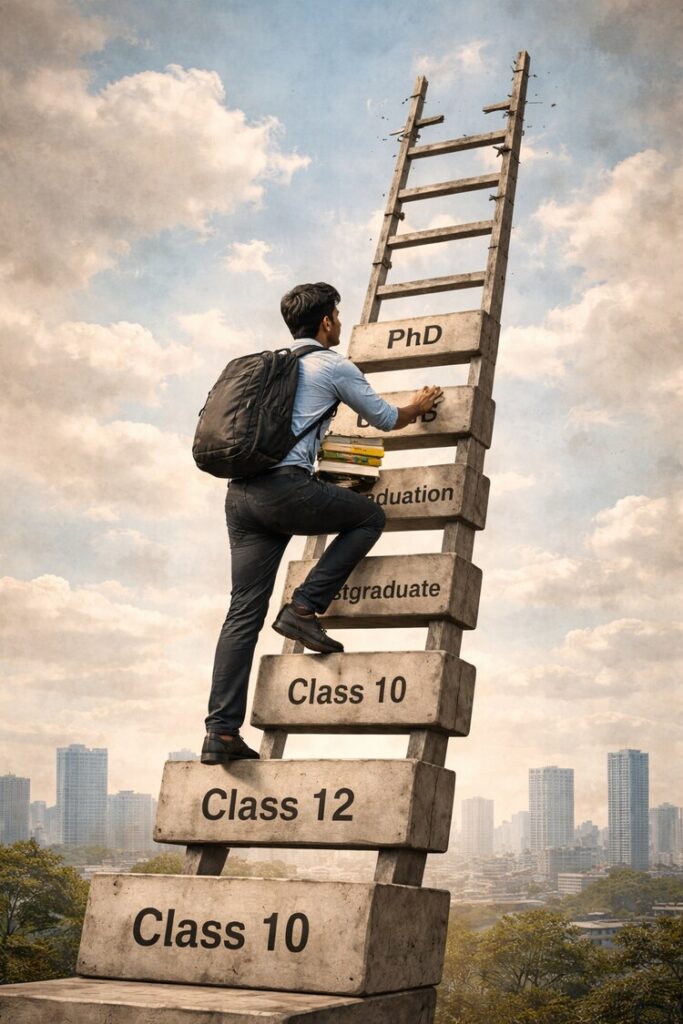
The ILO also estimates that returns to education have declined over time, although graduates and postgraduates continue to have higher estimated returns than those with only secondary or higher-secondary education.
So the answer is not that “degrees are useless.”
They are not.
The economic value of a degree increasingly depends on what the degree is, where it was obtained, what skills accompany it, and whether the economy is creating jobs that require those skills.
When skills send a different economic message
Consider the everyday Indian economy.

A competent electrician can develop a loyal customer base. A plumber can charge according to urgency and expertise. A mechanic with specialised knowledge can earn well. A successful small shopkeeper can generate more income than an entry-level salaried employee.
Meanwhile, a fresh B.A., B.Com., B.Sc. or even postgraduate may enter the labour market at a modest salary.
This is not evidence that education has failed.
It shows that the labour market rewards scarcity, productivity, demand and entrepreneurship—not certificates alone.
The auto-driver versus postgraduate: A comparison!
The statement that “an auto driver earns more than a postgraduate” may certainly be true in individual cases, but it cannot be presented as a universal statistical fact.

An auto driver’s ₹30,000 may be gross receipts, from which fuel, maintenance, EMI, insurance and other expenses must be deducted. A salaried graduate may receive provident-fund contributions, paid leave, health insurance and other benefits.
Yet the comparison exposes an important reality:
A degree no longer guarantees a high starting income.
India is producing graduates faster than high-quality graduate jobs
According to the Ministry of Education’s AISHE 2021–22, higher-education enrolment reached approximately 4.33 crore students, compared with 3.42 crore in 2014–15. The country had 45,473 colleges registered with AISHE, while around 1.07 crore students passed out during that academic year.
The expansion of higher education is undoubtedly a major achievement.
But it creates another question:
Where are the corresponding jobs?
A university can produce a graduate in three years. A postgraduate can be produced in five. But high-productivity jobs cannot simply be manufactured by increasing college enrolment.
That is where the mismatch emerges.
The employability problem
The India Skills Report 2025, based on the Global Employability Test and involving more than six lakh candidates, estimated India’s graduate employability at 54.81%.
This does not mean that 45% of all Indian graduates are unemployable. The report reflects its own assessment sample and methodology.
But it highlights a serious problem:
A university degree and employability are no longer synonymous.
Employers increasingly seek communication, analytical ability, digital competence, problem-solving, adaptability, teamwork and practical experience alongside academic qualifications.
A student may know the textbook perfectly and still struggle to perform effectively in the workplace.
The real divide is no longer “degree versus no degree”
The choice should not be:
College OR skill
It should increasingly be:
College + skill + experience + adaptability
A graduate who also knows data analysis, accounting software, digital marketing, design, AI tools, communication or entrepreneurship may have a very different labour-market position from someone possessing the same degree without these capabilities.
Similarly, a student choosing an ITI, polytechnic, nursing programme, hospitality course, healthcare technology programme or other vocational pathway should not be regarded as having “failed” to enter university.
India needs both scholars and skilled technicians.
A nation cannot function without teachers, researchers, economists, engineers, doctors and administrators. But neither can it function without electricians, mechanics, machinists, plumbers, technicians, construction workers, drivers, artisans and entrepreneurs.
What the earnings data tell us
The evidence does not support the simplistic conclusion that education has stopped paying.
An IMF analysis using PLFS data from 2017–18 through 2023–24 estimates that an additional year of formal schooling in India is associated with roughly a 6–7% increase in earnings. It also finds positive returns from technical and formal training.
Formal training, according to the analysis, is associated with an earnings increase of about 18.5%, while on-the-job learning is associated with about 7.3%.
The message is therefore clear:
The future is not degree-less; it is increasingly skill-intensive.
The danger is not that young people will stop studying
The greater danger is that they will start asking:
“What exactly am I studying for?”

If a postgraduate struggles to find a ₹20,000-a-month job while a skilled technician earns considerably more, the student’s concern is understandable.
If college fees, accommodation and transportation costs are high, the return on investment in education becomes a legitimate consideration.
Education must therefore answer not merely:
“What degree will you receive?”
but also:
“What can you do with it?”
India’s demographic dividend depends on this question
India’s greatest advantage is its young population.
But a young population becomes an economic dividend only when young people are educated, skilled, employable, productively employed and adequately paid.
For India, therefore, job creation is as important as degree creation.
What should colleges do?
The answer is not to close colleges or discourage higher education. Instead, colleges must change.
1. Make every degree employability-oriented
A graduate should leave with communication skills, digital literacy, data handling and at least one marketable practical competency.
2. Make internships integral
Students should experience the workplace before graduation.
3. Bring industry into the classroom
Curricula must reflect changing workplace requirements.
4. Give vocational education social respect
There is nothing inferior about becoming an excellent electrician, technician, machinist or entrepreneur.
Skill is dignity.
5. Publish employment outcomes
Students and parents deserve to know the percentage employed, median starting salary, higher-study rate and other post-graduation outcomes.
A college should be accountable not merely for admissions and examinations, but increasingly for student outcomes.
What about the small shopkeeper?
A successful shopkeeper is not simply “someone who did not go to college.”
He or she may possess market intelligence, customer-management skills, purchasing ability, inventory management, accounting, negotiation, risk-taking ability and entrepreneurial judgement.
In other words, the shopkeeper may possess skills that formal education never certified.
The lesson is not that every graduate should abandon education and open a shop.
It is this:
The economy rewards capability, not merely certification.
We should stop asking, “Degree or skill?”
That is a false choice.
India needs a three-layer education model:
Knowledge — understanding the world.
Skill — being able to do something valuable.
Adaptability — being able to learn, change and continue learning.
The university of the future cannot simply produce degree holders.
It must produce problem-solvers.
The real “degree crisis” is a crisis of confidence
The viral graphic may exaggerate the scale of the problem, but it touches a genuine concern.
India has invested enormously in expanding higher education. With 4.33 crore students already enrolled, the question is no longer simply how to get more young people into colleges.
The harder question is:
How do we ensure that the education they receive creates economic value, social mobility and meaningful work?
If that connection weakens, young people will naturally reconsider the value of a conventional degree.
The danger, therefore, is not necessarily the collapse of colleges.
It is the collapse of faith in the promise that education automatically leads to a better life.
That would be far more serious.
The final lesson
A plumber earning ₹50,000 is not a failure because he does not possess a degree.
An MBA earning ₹25,000 is not a failure because his salary is modest.
Income alone cannot measure the worth of a human being or the value of education.
But income is an important economic signal.
When society repeatedly sees skills commanding higher immediate market value than qualifications, education policy must listen.
The answer is not:
“Don’t go to college.”
Nor is it:
“A degree guarantees success.”
The honest message should be:
Study—but learn to do.
Earn a degree—but acquire a skill.
Seek knowledge—but understand the market.
And never confuse a certificate with competence.

India’s future does not depend on producing more degree holders alone.
It depends on producing a generation that is educated, skilled, adaptable and economically productive.
Because the real crisis before India is not a degree crisis.
It is the widening distance between what we teach, what young people learn, and what the economy is willing to pay for.
And if that distance continues to grow, the next generation may not stop believing in education.
They may simply ask:
“What is the economic value of the education you are asking me to invest my youth in?”