
India & World UpdatesHappeningsBreaking NewsFeature Story
Women’s Reservation Bill and Delimitation in India: Reform, Representation, and the Politics of Implementation, written by Dr. Manoj Kumar Paul
//Dr. Manoj Kumar Paul//
(Former Principal, Women’s College, Silchar)
Introduction: Between Promise and Political Reality
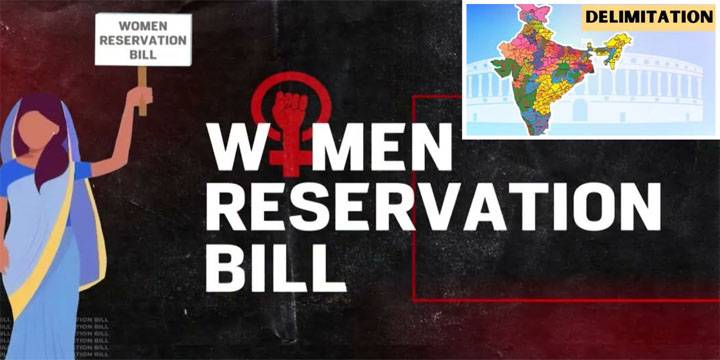
India’s democratic journey has long grappled with the challenge of ensuring equitable representation across gender, caste, and region. The passage of the The Constitution (106th Amendment) Act, 2023—popularly known as the Women’s Reservation Bill—was widely hailed as a historic step toward correcting gender imbalance in legislative bodies. Yet, the optimism surrounding the reform has been tempered by the conditionality attached to its implementation: it will come into force only after a fresh census and subsequent delimitation.
The developments of 2026—particularly the failure of the Constitution (131st Amendment) Bill aimed at enabling delimitation-linked implementation—have transformed the issue into a major political flashpoint. What began as a consensus-driven social reform has now evolved into a contested terrain where questions of federal balance, electoral strategy, and institutional timing intersect. The debate is no longer about whether women should be represented, but about how, when, and under what structural conditions that representation should be realized.
Government’s argument: Structural Reform, Not Symbolic Gesture
The ruling establishment has consistently framed the Women’s Reservation policy as a transformative intervention rather than a mere political promise. Union Home Minister Shri Amit Shah has been at the forefront of defending both the bill and its linkage with delimitation.
1. Correcting Historical Underrepresentation
The government argues that women’s participation in Parliament—hovering around 14%—is structurally inadequate. According to global benchmarks set by bodies like the Inter-Parliamentary Union, India lags behind several developing nations. Reservation is thus framed as a corrective constitutional mechanism, not an act of political charity.
2. Delimitation as a Precondition for Fairness
A central pillar of the government’s argument is that reservation cannot be implemented on an outdated electoral map. Amit Shah emphasized that:
Constituencies must first be rationalized based on current population data
Only then can reservation be meaningfully and equitably distributed
Without delimitation, reservation could lead to distorted representation, where some regions are overrepresented while others remain underrepresented.

3. Expansion of Lok Sabha as Inclusive Growth
The proposed 2026 reform sought to expand Lok Sabha seats significantly. The government argued that:
Expansion would accommodate reservation without displacing existing political actors
It would allow more equitable representation for growing populations
This approach was presented as a win-win model, ensuring both gender inclusion and demographic justice.
4. Reassurance to Southern States
One of the most politically sensitive concerns has been the potential disadvantage to southern states. Shah assured Parliament that:
No state would lose absolute representation
Even southern states would see an increase in total seats, though proportional shares may shift
This argument attempts to balance population-based justice with federal sensitivity.
5. Avoiding Tokenism: Institutionalizing Reform
The government has repeatedly argued that immediate implementation without structural adjustment would amount to tokenism. By linking reservation with delimitation, it seeks to:
Embed reform within a long-term constitutional framework
Avoid ad hoc or temporary arrangements
6. Administrative and Logistical Rationality
Another argument advanced is practical:
Conducting delimitation and reservation simultaneously reduces administrative duplication
Electoral machinery can adapt to one comprehensive reform instead of multiple staggered changes
7. Moral Framing and Political Messaging
Prime Minister Narendra Modi and other leaders have framed opposition resistance as a denial of women’s rights, portraying the bill as a moral imperative rather than a negotiable policy.
Opposition’s Counter-Arguments: Reform Delayed or Reform Denied?
While most opposition parties support women’s reservation in principle, they have strongly opposed the government’s approach.
1. “Delayed Implementation Equals Denial”
The most fundamental criticism is that linking reservation to delimitation effectively postpones its benefits:
Census timelines remain uncertain
Delimitation could take several years
Implementation may be pushed to 2029 or beyond
Opposition leaders argue that a reform delayed indefinitely is functionally equivalent to a reform denied.
2. Women as a Political Instrument
Critics allege that the government is using women’s reservation as a political shield to push delimitation. The argument is that:
Public support for women’s rights is being leveraged
To introduce a politically advantageous restructuring of constituencies
This has been described as “using women as a decoy for electoral engineering.”
3. Fear of Gerrymandering
Opposition parties have raised concerns about potential manipulation of constituency boundaries:
Redrawing seats could favour ruling party strongholds
Marginal constituencies could be reshaped strategically
Even though delimitation is overseen by the Delimitation Commission of India, critics argue that institutional neutrality is not immune to political influence.
4. Threat to Federal Balance
Perhaps the most serious concern relates to India’s federal structure:
Northern states with higher population growth may gain more seats
Southern states, despite better governance indicators, may lose relative influence
Opposition leaders warn that this could:
Create regional resentment
Undermine cooperative federalism
5. Absence of OBC Sub-Quota
Parties like the Samajwadi Party and RJD have highlighted the lack of reservation for OBC women:
They argue that without sub-quotas, benefits will be skewed toward elite groups
This raises questions about intersectional justice
6. Rotation of Reserved Seats
Another concern is the rotation mechanism:
Frequent rotation may discourage long-term constituency development
Politicians may lack incentive to invest in areas they cannot contest again
7. Disruption of Political Continuity
Opposition leaders argue that:
Large-scale reservation combined with delimitation could disrupt existing political networks
Experienced legislators may be displaced abruptly
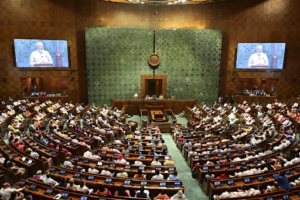
8. Questioning the Timing
The introduction of delimitation-linked reforms close to electoral cycles has raised suspicion:
Critics see it as a pre-election strategy
The delay between passage and notification has further fueled distrust
The 2026 Legislative Setback: A Moment of Reckoning
The failure of the delimitation-linked constitutional amendment in April 2026 marked a significant political moment. The bill aimed to:
Expand Lok Sabha seats from 543 to around 850
Enable implementation of women’s reservation through new constituencies
However, it failed to secure the required two-thirds majority, highlighting:
The limits of unilateral reform
The necessity of political consensus
This outcome underscores that while gender justice enjoys broad support, the methodology of implementation remains deeply contested.
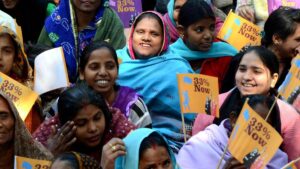
Deeper Analytical Insights: Competing Visions of Democracy
At its core, the debate reflects two competing visions:
Government’s Vision
Long-term structural reform
Population-based representation
Institutional integration of gender justice
Opposition’s Vision
Immediate implementation
Protection of federal balance
Safeguards against political misuse
Both perspectives are rooted in democratic principles, yet they diverge sharply in priorities.
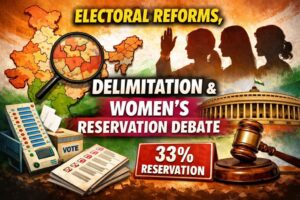
Conclusion: Between Aspiration and Execution
The Women’s Reservation Bill represents one of the most ambitious attempts to reshape India’s democratic framework. However, its entanglement with delimitation has transformed it into a complex political issue.
The government sees the linkage as a necessary structural step, while the opposition views it as a strategic delay and potential manipulation. The truth likely lies in a nuanced middle ground—where both structural integrity and timely implementation must be balanced.
Ultimately, the future of women’s representation in India will depend on:
Building cross-party consensus
Ensuring transparency in delimitation
Addressing regional and social concerns
Until then, the promise of one-third representation remains a powerful yet unrealized vision—symbolizing both progress and the persistent challenges of democratic reform.