
India & World UpdatesHappeningsBreaking NewsFeature Story
When the Earth Trembles: Ululation and Kasar Striking Become a Language of Communication, written by Swapnodeep Sen
//Swapnodeep Sen//
Communication is often understood as the exchange of words, symbols, or gestures that help people connect with one another. But in Bengal and some Parts of Assam and Tripura, during moments of fear and uncertainty such as earthquakes, communication takes a unique and deeply cultural form: the sharp trill of uludhoni (ululation) and the metallic resonance of kasar (brass or bronze plates). These sounds, though non-verbal, have historically acted as powerful communicative tools—signaling danger, expressing collective emotions, and binding communities together when the earth beneath them begins to shake.
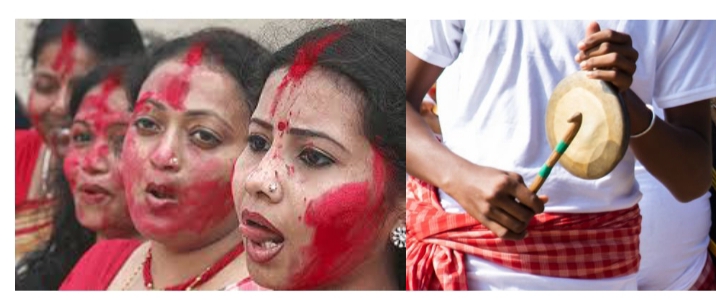
The practice of uludhoni—a high-pitched, rolling cry produced by women through rapid tongue movements—is much more than a sound. In everyday culture, it communicates joy and auspiciousness during weddings and festivals. Before modern communication tools, ululation was a loud, far-reaching sound that could convey messages quickly. For example, in parts of Africa, it could announce a visitor, a warning, or a communal event. But in the context of an earthquake, uludhoni shifts its communicative purpose. It becomes an audible outpouring of fear and anxiety, expressing what words often fail to capture in moments of crisis.
Uludhoni is also communicative in its reach. When a woman raises her voice in this way, others hear it and immediately recognize that something unusual is happening. It functions almost like an alarm, alerting those nearby while also assuring them that they are not facing the danger alone. The sound carries emotional weight, transmitting both the gravity of the situation and the solidarity of shared experience.
The striking of kasar (brass plates or cymbals) adds another layer of communication. These resonant sounds ripple across courtyards, lanes, and villages. Traditionally believed to chase away evil forces, kasar also performed the very practical role of a signaling device in a time before loudspeakers or sirens. Its loud clangs reached neighbors and distant households, effectively communicating the message: “The earth is shaking—come out, take care, protect yourselves.”
Thus, kasar served both symbolic and functional purposes in communication. On one hand, it reassured people through ritualistic faith; on the other, it worked as a public warning system long before scientific earthquake alerts were available.
Together, uludhoni and kasar illustrate how sound itself becomes a form of communication. Unlike written or spoken words, these are instinctive, culturally recognizable signals that convey meaning immediately. They communicate fear, urgency, and solidarity across boundaries of literacy, age, or social status. A child, an elder, or even a passerby can instantly grasp the meaning of these sounds without explanation.
In communication theory, this can be linked to the idea of non-verbal and symbolic communication—forms of expression that do not rely on structured language but still transmit strong messages. Uludhoni conveys emotional states, while kasar communicates collective action. Both together transform chaos into a kind of shared ritual, creating what anthropologists call a “community of response.”
In modern Bengal, with earthquake drills, scientific alerts, and mobile notifications, these traditional communicative practices are less central in cities. Yet, they survive in rural and semi-urban areas, reminding us that communication is not only about efficiency but also about meaning. While a siren alerts people to danger, uludhoni and kasar add cultural layers of reassurance and belonging. They express not just what is happening but also how people feel about it and how they respond together.
This duality—of practical signalling and emotional expression—shows how communication adapts across contexts. In moments of disaster, when language may falter, sound takes over. The ringing of a plate or the piercing cry of uludhoni becomes a message, a warning, and a symbol of resilience all at once. It is a language without words, yet rich with meaning, echoing across generations as a testament to the enduring bond between culture, communication, and survival.