
Barak UpdatesHappeningsCultureBreaking News
Barunjyoti emerges rock star of debate on Tagore’s relevance in contemporary times, writes Shanku Sharma
//Shanku Sharma//
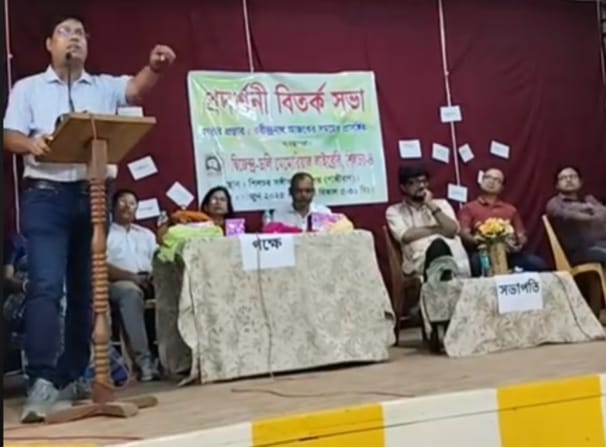
The intellectually charged event, held at the Silchar Sangeet Vidyalaya Auditorium, attracted a full house, underscoring the enduring relevance and emotional resonance of Rabindranath Tagore’s legacy.
It was heartening to witness such a robust turnout for a debate competition, particularly in an era dominated by smartphones and K-dramas.
The auditorium was alive with literature enthusiasts, students, professors, journalists, and members of civil society, all eager to partake in a balanced and spirited exchange of ideas.
Presiding over the session was Prof. Biswatosh Chowdhury, whose insights during the summation imparted academic gravitas to the occasion. The debate was structured along parliamentary lines, with two benches—one advocating for and the other opposing the motion—comprising distinguished speakers from academia and the literary realm.
Leading the bench in favor of the motion was Dr. Debashish Bhattacharjee, accompanied by Dr. Meghmala Dey, Papri Bhattacharjee, and Dr. Ramakanta Das. Their collective arguments underscored the moral and philosophical profundity of Tagore’s writings and his visionary conception of a world characterized by harmony, creativity, and universalism. They elaborated on how his works—encompassing literature, music, education, and rural development—remain not only timeless but increasingly indispensable in today’s fragmented socio-political landscape.
Dr. Bhattacharjee observed that Tagore’s essays on nationalism present a much-needed counterpoint to the escalating tide of extremism, while Dr. Dey emphasized the ongoing significance of Shantiniketan’s educational model, particularly in an era where rote learning and commercialization prevail in the Indian education system. Papri Bhattacharjee highlighted how Tagore’s poetry continues to serve as an emotional anchor for individuals during tumultuous times.
On the opposing bench, presenting a robust and incisive critique, were Dolonchapa Daspaul, Prof. Rintu Das, Dipak Sengupta (who led the team), and Dr. Barunjyoti Choudhury—the standout of the debate (details to follow). Their collective argument interrogated whether Tagore’s ideology, rooted in early 20th-century liberalism, can adequately address the socio-economic complexities and technological transformations of the 21st century.
Prof. Das offered a nuanced critique of Tagore’s gender perspectives within his literary oeuvre, suggesting they often lacked the necessary intersectional sensitivity. Dr. Choudhury, while acknowledging Tagore’s historical contributions, challenged the audience to explore newer voices and emerging thinkers more adept at grappling with the dilemmas of modern globalism, the climate crisis, and identity politics.
The session commenced with two melodious Rabindra Sangeet performances by Nilaksha Choudhury, director (administration), Dainik Jugasankha Group of Publications, setting a tone of cultural reflection for the evening. The event was deftly conducted by Shyamananda Choudhury and Sujit Kumar Das, who maintained the rhythm and decorum of the debate with commendable poise.
Dr. Durba Deb, Dr. Piyali Deb, Priyasmita Bhattacharjee, and Debomita Roy Choudhury represented the library. The evening culminated with a vote of thanks, followed by informal discussions and group interactions that extended beyond the formal debate.
In an era when public discourse is often polarized or superficial, this initiative by the Dwijendra-Doli Memorial Library emerged as a beacon of thoughtful engagement and critical appreciation. The event not only reignited conversations surrounding the enduring value of Tagore’s philosophy but also provided a much-needed platform for debating relevance versus reverence.
Though I am not a judge, I must note that Dr. Barunjyoti Choudhury (Department of Bengali, Assam University, Silchar) electrified the exhibition debate. Without hesitation, he captivated the audience within the allotted six minutes for each speaker, delivering arguments that garnered both applause and laughter. He was the standout performer.
Dipak Sengupta was exceptionally brilliant. I was captivated by his arguments. I also held great admiration for Dr. Debashish Bhattacharjee, Dolonchapa Daspaul, and Papri Bhattacharjee.