Barak UpdatesHappeningsBreaking NewsFeature Story
Manasa Katha and Manasa : Two Successful Productions, Review by Rahul Dasgupta
Production by Bhabikal, Director: Santanu Paul
//Rahul Dasgupta//
Today, theatre belongs to the director. Even if the playwright and the principal actor of a play are the same person, it is the director who has the final say about the production. Whatever way a play may have been written, the director decides how it will be presented and in what form.
The play that prompted me to make these observations is Manasa, produced by the Silchar theatre organisation Bhabikal. Bhabikal has already presented this play five or six times. The fifth production, however, was an exception; I shall return to that later. The original play was written by the distinguished Barak Valley actor, director and playwright Shekhar Debroy, and is titled Manasa Katha. The play remains relevant to the struggle to protect the rights of people in the Barak Valley against deprivation and discrimination.
The play has found a place at the universities of Calcutta and Tripura, and it has also been included in a Refresher Course at Assam University. In this connection, Shekhar Debroy’s play The Theory of Yudhishthira is also included in the syllabus at Calcutta University.
Under Shekhar Debroy’s direction and in his solo performance, Manasa Katha was first staged in Silchar in 2000. Since then, Debroy has performed this solo play in many places across the country. He even took it beyond the country’s borders and performed it in Bangladesh in 2002. The music, dialogue and acting in the play hold audiences spellbound.
It should be noted that in 2001 the play was also staged in a group production in Bangladesh, under the direction of the late Rajib Deb, a distinguished theatre personality associated with the Prominyam Group of Sylhet, Bangladesh. The play was also performed in Tripura and Bangladesh under the direction of Sanjay Kar, a noted theatre actor and director. Manasa Katha was not confined to the stage alone…
…for Bishwajit Shil, a distinguished documentary filmmaker from the Barak Valley and a critic of theatre and cinema, made a documentary based on the play, which was broadcast by Silchar Doordarshan.
For the convenience of this discussion, it is necessary to refer to the presentation of Manasa Katha directed by Shekhar Debroy.
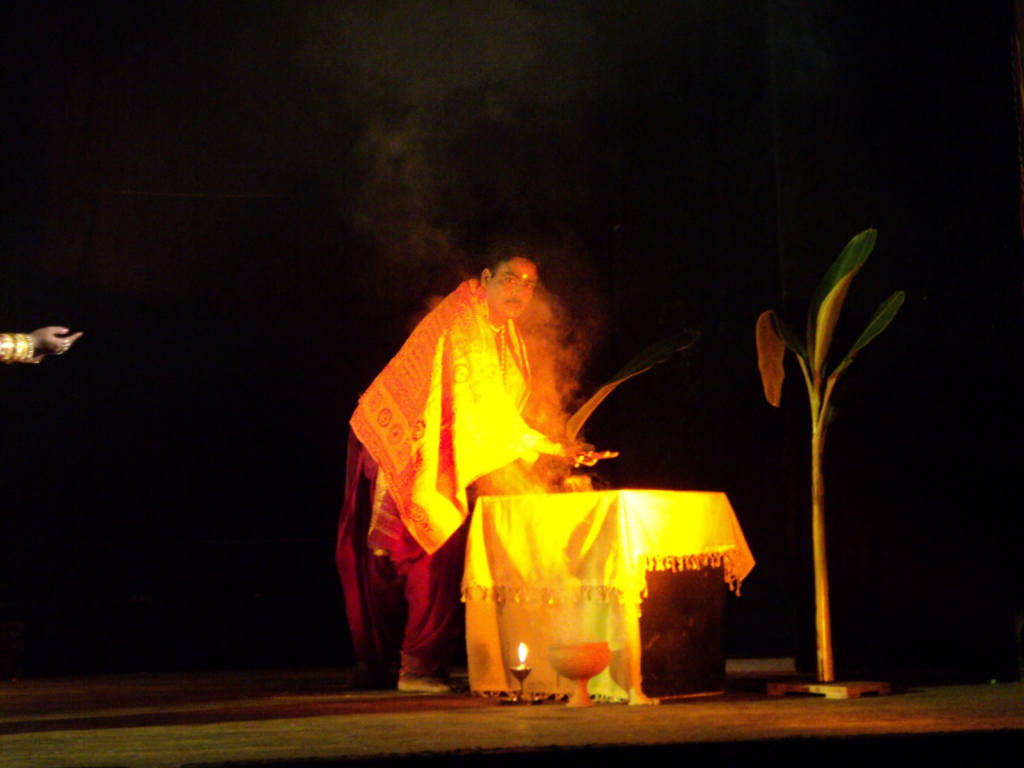
One noteworthy feature of Manasa Katha, directed and performed by Shekhar Debroy, is its stage design. Drawing on a widely known and much-discussed mythological folk narrative or poetic tale, the playwright does not deviate even slightly from the original narrative. With remarkable skill, he uses it to address the rights of deprived people in the present economic, social and political context. At the same time, his direction—particularly the stage design—adds another dimension beyond his solo acting. Shekhar Debroy demonstrates, through exceptional creative thought and skill, how a simple, unadorned stage and very ordinary materials can make a play far more expressive and meaningful.
What did the stage design consist of? In rural areas, Patua artists travel from house to house with painted scrolls, narrating stories or ballads as they sing. In a similar scroll-painting style, two pictures were hung on the right and left sides of the stage, from the audience’s perspective. They were held on two stands placed on either side of a central altar. On the black cyclorama at the back were two parallel, irregular white lines. The picture on the right showed a woman’s face, her black hair resembling the hooded snake above the head of the goddess Manasa. The image raises a question: is it simply the goddess Manasa painted on a scroll, or is it also a symbolic representation of a woman in protest—or is it both?
In the same way, another visual tension is created in the audience’s mind. On the scroll to the left of the stage are only the two feet of a man wearing nagrai shoes. Do these feet symbolise the arrogance of Chand Saudagar, who tramples the serpent community? Or do they represent the pride of a patriarchal society living in a feudal order? The feet, together with the crooked lines across the black backdrop, may symbolise the river Gangur from the Manasa Mangal tradition—or the marginalised serpent community struggling for its livelihood amid the tides and currents of the river.
Does the snake, the vehicle of Manasa, symbolise that marginalised community? Such questions repeatedly arise in the audience’s mind, creating tension and contradiction. Through the process of thesis, antithesis and synthesis, the director gives the play a new dimension. As the play proceeds, the woman on the scroll becomes, at different moments, the goddess Manasa and a symbol of oppressed women. At times the two identities merge into one image.
On the other hand, the two feet on the scroll become a concrete symbol of the arrogance with which the legitimate rights of exploited and oppressed people are trampled upon in our political and social life. These images cannot be confined to a specific geographical boundary, just as the two crooked lines on the backdrop cannot be confined to one fixed meaning. At times they suggest a snake; at others, the waters of the Gangur carrying the body of Lakhindar; and at still others, they evoke the familiar Barak, Longai and Kushiyara rivers, with the bodies of language martyrs floating in their waters. They also seem to narrate, without interruption, the joys, sorrows and struggles of human life.
What Shekhar Debroy achieves through the writing of the play, the director also achieves through the stage design: with a modern and creative imagination, he adds a dialectical dimension to the production.
From Shekhar Debroy’s Manasa Katha, directed and performed by him, let us now turn to Manasa, directed by Shantanu Pal.
Shekhar Debroy’s solo Manasa Katha is an experimental, epic-style religious presentation in a distinct form. What Debroy achieved through his solo performance is truly exceptional in the Barak Valley. But does that mean that an original play from this valley can only be successful as a solo performance by a skilled actor?
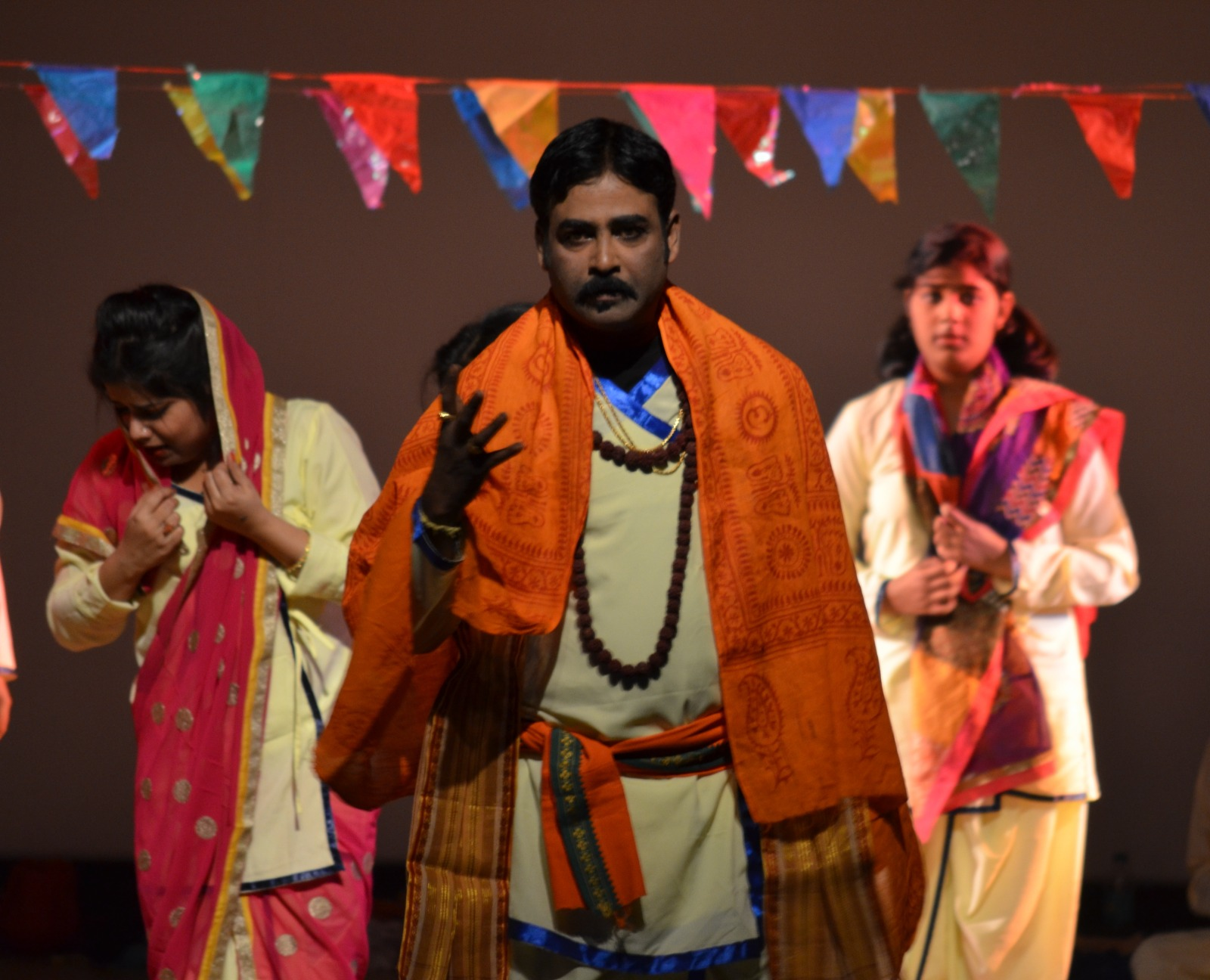
After extensive rehearsals with theatre workers and artists trained in workshops conducted by Bhabikal and Kala Academy, Manasa was staged under Shantanu Pal’s direction in the auditorium of the Silchar District Library in 2010. The tireless work and collective effort of around thirty-five performers produced a successful play by a trained and disciplined theatre team. The stage, lighting, music, dance and costumes together made it a colourful production.
The production also demonstrated the director’s ability and dedicated effort in developing a large body of trained theatre workers for theatre practice in the Barak Valley. Through the joint initiative of Bhabikal and Kala Academy, Manasa was presented in this same form five times in total—once in Karmangar and four times in Silchar. [The place-name in the source is unclear.]
However, the performance of Bhabikal’s Manasa at Banga Bhavan in Silchar on 27 January 2015 was an exceptional production. Having achieved success with the earlier form on five occasions, director Shantanu Pal set that form aside completely and had the courage to present the play in an entirely new style. The music, costumes and stage were all different from those of the earlier production.
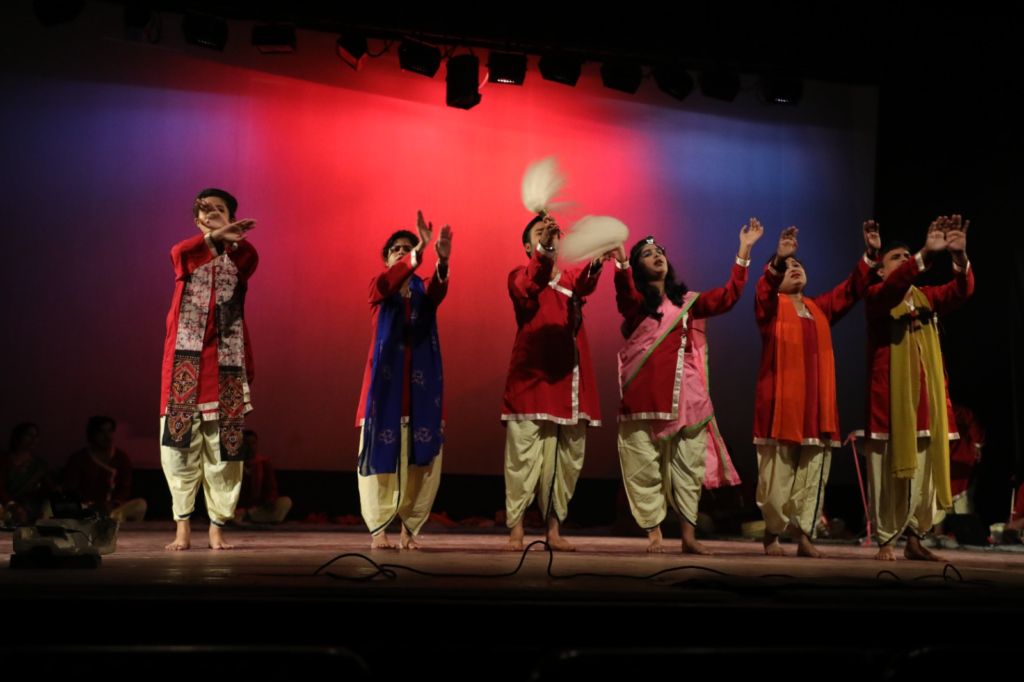
When the curtain was drawn aside, the performers were seen slowly coming onto the stage in orderly lines from the right and left sides of the auditorium. The actors did not appear as a separate category of people; rather, they seemed like members of the audience who had risen from their seats. The director appeared to be suggesting that today’s actors and actresses are, in a sense, the audience themselves—and that the audience is central. Twenty-one performers came onto the stage and sat in a semicircle at the very upstage area.
An atmosphere of sound began. There was no recorded music. The performers seated on stage created a distinctive concert-like sound using drums, cymbals, handclaps and other instruments. The sound might bring to mind the musical accompaniment of jatra, Padavali songs or Manipuri sankirtan. All these elements blended to create a different, unusual musical atmosphere at the very beginning of the play.
Before a performance begins, this kind of loud, unified instrumental music is also reportedly played in the Bengali folk-theatre form jatra pala and in yangko theatre, which developed from Chinese traditional folk song and dance. The musical ensemble signals to the audience that the performance is about to begin and draws their attention.
When the concert-like opening of Manasa ended, the performance began with a devotional song and dance. The characters came onto the stage one by one from upstage and took up their roles according to their characters. The stage properties consisted of two triangular cut-outs, one on each side of centre stage, and two wooden boxes used as seats. At one point, these four objects were joined together to create Chand Saudagar’s seven-masted ship, Madhukar—an extraordinary moment of theatrical invention. The production shows how even very ordinary objects can be made mobile, lively and theatrically useful.
Two dancers perform with the devotional song. The dance appears another two or three times in the play, sometimes as a solo and sometimes as a duet. At one point, Shankar dances while playing the pakhawaj with the actors Jewel and Birabrata. Wonderful! Such work is impossible without practice, concentration and, above all, regular training.
Since 2007, Bhabikal and Kala Academy have regularly conducted theatre workshops, and since 2014 they have introduced a six-month course for theatre training. The results of these initiatives can be seen in the performers of Bhabikal today.
In fact, given the form and style in which the director has presented Manasa, a successful production of this kind would be extremely difficult without proper theatre training. The director and theatre workers of Bhabikal must surely have recognised this, which is why they have continued regular practice and theatre training; the benefits of that effort extend well beyond the production itself.
The dance mentioned above should not strictly be called an ojha dance. Nevertheless, the director’s choreography, which fits the play, demonstrates his creativity. Its form, rhythm and flavour are different. A production becomes successful when its elements are properly integrated with the acting.
Certainly, there are two or four principal characters in a play, but in the structure given to Manasa by the director, it is difficult to determine who is principal and who is secondary. To make that distinction would itself be a mistaken exercise, because the play’s form makes every actor and actress a working artist.
Characters such as Chand, Manasa, Sanaka and Behula are prominent, but do the roles of Lengra, Lilai, Dalai, Jalu and Malu attract the audience any less or seem less important? Certainly not. Depending on the character, these performers are the driving force of the play and indispensable to its structure. In different scenes, one or more of them take on principal roles. Sometimes they speak; sometimes they communicate silently through expression. In places, their physical acting itself becomes the language through which the play can be enjoyed.
Almost every performer in this production plays more than one role. One point about the acting must also be mentioned: the two narrators, or sutradhars, connect one scene to another and move the play forward by describing or explaining events. These roles are usually performed by experienced actors. Here, however, the director entrusted them to two young performers who had only recently passed beyond adolescence. The correctness of this bold decision was demonstrated by their performances. The narrators, Sayanti Bhattacharya and Sayantani Pal (Mithi), both earned generous praise from the audience.
It is worth noting that the performers have carefully mastered the language used by the playwright and have preserved its style intact throughout the play, including in the delivery of the dialogue.
Director Shantanu Pal has experimented extensively with the form of the play and its techniques of application, giving the audience something extra.
Shekhar Debroy’s Manasa Katha, based on the widely known folk poem Manasa Mangal, is in no way a conventional folk play. Its readers and audience are primarily an educated, urban audience—a socially and intellectually aware public. Therefore, both directors had to experiment with theatrical form and performance techniques to make the work accessible and compelling to such audiences.
There can be no doubt about this. The two productions bear witness to the directors’ styles. In Shekhar Debroy’s Manasa Katha, the Patua scroll-painting tradition is present, but it is not a literal copy. The emphasis is on individual creativity in the mode and technique of performance. Shantanu Pal, however, has presented Manasa in two distinct forms. The first four performances followed the conventions of the proscenium stage, using varied lighting, costumes and stage properties to create variety. The music was performed outside the stage, in front of the audience. But the Manasa staged at Banga Bhavan, Silchar, on 27 January 2015 was exceptional in every respect. It was also the first play to be staged on the newly constructed Banga Bhavan stage.
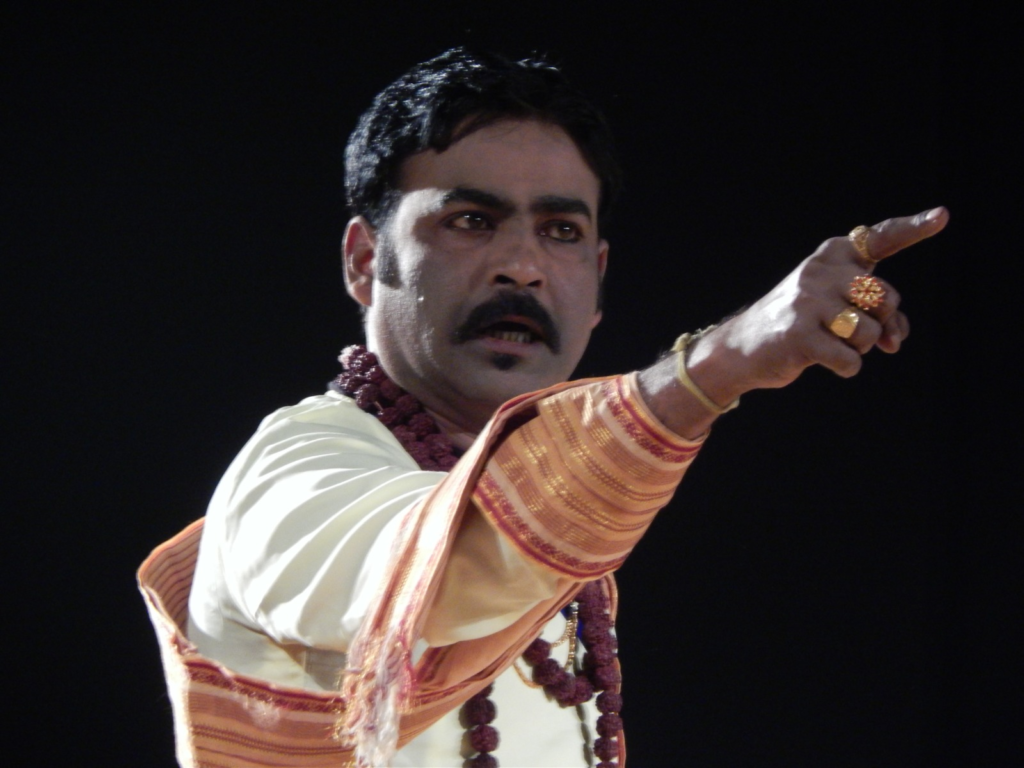
In this production, the director discarded the usual conventions of stage theatre and presented Manasa in a new form. Although it was performed on the modern stage of a well-equipped auditorium, the production was not confined by the height of the stage: it could also be performed at the audience’s level. In other words, it could be staged in an open space under the open sky. Its form was free from the enclosure of the conventional stage and was lean and unencumbered.
The play’s performance method, structure and form are mixed, and in that sense different. In Manasa, elements of Bengali jatra, the ojha dance of the Barak Valley and a nearly extinct local form can be discerned. The play moves forward like a wave, through the construction and breaking up of short scenes. Yet it does not follow any one fixed gesture or convention. By emphasising experimentation, creative technique, dramatic structure and presentation, the director takes audiences beyond conventional ways of thinking about theatre and gives them an opportunity for new thought and analysis. This is where the play becomes engaging and acceptable to its audience. Although the production experiments, it does not undermine the play’s central subject, originality or momentum. I shall now describe one scene that particularly caught the audience’s attention.
Kalanagini assumes the natural appearance of a woman, deceives the guards, hides herself amid the commotion of a wedding house and emerges from her disguise at the appointed time. But she must kill an innocent, handsome man who is sleeping peacefully, a man with whom she has no direct enmity—and she must do so on a night meant for a tender union. How can this be possible for a woman? The more Kalanagini looks at the gentle, radiant, sleeping man, the more she seems to feel the natural pull of innocent love in a woman’s heart. On one side is a soldier bound by duty and a profound sense of responsibility; on the other is the obligation to take the life of an innocent person. Her heart is pierced by an extreme psychological conflict.
At that crucial moment, the sleeping Lakhai accidentally strikes Kalanagini. In that instant, a woman’s dormant self-respect and sense of dignity seem to awaken, and the accumulated anger of oppressed women appears to surge into revenge. Without delay, Kalanagini raises the sharp implement kept on her head and strikes. The action becomes evidence of a woman’s presence and her retaliation.
It is a remarkable piece of scene-making. The director allows three aspects of a woman’s character to appear distinctly before the audience, while also removing the scene from the wrapping of the supernatural and presenting it in a realistic, logical and convincing way. The scene is created through a particular point of view.
In many respects, this is a successful production by Bhabikal. Nevertheless, although the shortcomings noticed by a spectator are minor, they should be mentioned.
First: Sanaka and, in some sections, the boatmen’s excessive emotionalism sometimes makes their dialogue delivery unclear and monotonous, creating difficulties for the listener. This needs to be controlled.
Second: there could have been more variety in the colours of the costumes. In particular, the costumes of the women characters could have been developed further through additional practice and presentation.
Third: if Lakhindar’s wedding bed had been placed a little higher on the stage, the scene might have been more enjoyable to watch. Perhaps the director avoided doing so in order to eliminate an excess of stage properties.
Fourth: although the use of the song “Gram Chhara Oi Ranga Matir Path” (“That Red-Earth Road Beyond the Village”) may be regarded as an experiment, it seems somewhat out of keeping with the central musical tone of the play.
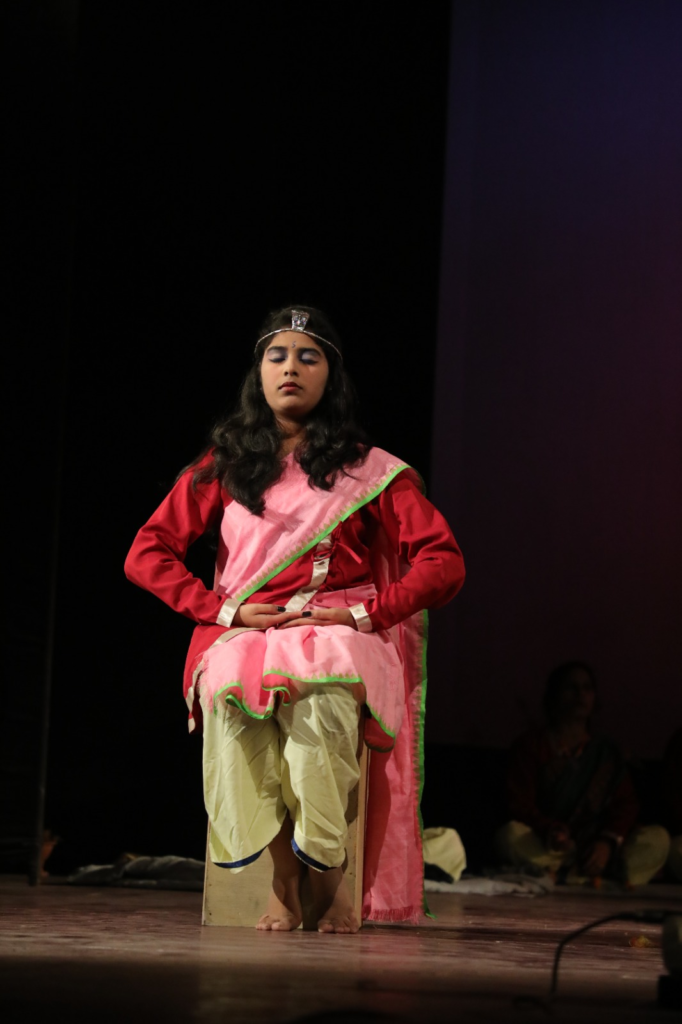
The lighting of the production deserves mention. The lighting designer demonstrated skill and professionalism in the arrangement and projection of light. Despite various technical shortcomings, difficulties and obstacles on the new stage, the lighting and staging were not compromised. On the contrary, the creative and skilful projection of light created beauty in the scenes and deserves praise. The lighting designer had come all the way from distant Imphal to Silchar for the play, and that effort deserves special recognition. [The name in this passage is unclear in the source text.]
The songs in this production truly deserve praise. The participation of Debapriya Nag and others made the play even more enjoyable. The singing by actor and director Shantanu Pal also earned the audience’s appreciation. The songs performed by the cast bore the mark of professionalism. They did not merely entertain the audience; they also helped the audience connect more closely with the central mood of the play.
I have discussed the two distinct presentations of this play at such length because there are few precedents in the Barak Valley of an original play being presented and performed through experiments of this kind in different forms. As a theatre worker, I believe that the two presentations contain many elements that encourage us to think. Their experiments with form, presentation and performance techniques undoubtedly offer audiences a sense of something new.
The celebrated Indian film actor and theatre personality Naseeruddin Shah made a significant observation in an interview: “In our country, cinema is still the principal medium of entertainment. But the interest that the younger generation is showing in theatre at present may mean that they will create a new language for theatre.” [The quotation is translated from the Bengali text in the supplied source.]
Therefore, I shall conclude with this hope: may theatre workers in this valley continue their theatre practice, experimentation, rehearsal and ongoing training with the same expectation in their hearts, so that in the future they too may leave their mark by creating a theatrical language of their own for the region.
— Bhabikal has staged this play many more times in different places. Notable presentations include Agartala and Dinhata, Cooch Behar, in 2018. In addition, an invitation has come from Mumbai for a performance of the play in December 2026.