
Barak UpdatesHappeningsBreaking NewsFeature Story
The Saga of a Dimasa village (Part 3), written by Sanjib Deblaskar
//Sanjib Deblaskar//
3.
While walking through the kaccha roads the eyes have caught sight of the houses deserted, creepers climbing the tin roof and the bamboo fencing of the yards—in one such houses lived Gojendra Barman, the doctor always on the move, attending patients house to house in addition to performing his regular hospital duties, never bothering whether the patients could afford a consultation fee or not.
At the hospital premises Doctorbabu was a general practitioner, a dermatologist, an orthopedic adept at setting dislocated bones, a general surgeon lancing boils and minor abscesses with little more than a pair of scissors and a razor blade, a dentist extracting aching teeth, a pediatrician and an obstetrician as well, who, in countless village homes, assisted midwives in bringing new lives into the world.
The doctor was sometimes seen at the post office enquiring if any letter arrived for him. He took a quick look through the newspaper subscribed by the village schoolmaster before it reached its destiny. A gifted conversationalist, he would often engage senior students in lengthy discussions on national and international politics, speaking in polished Bengali interspersed with English expressions.
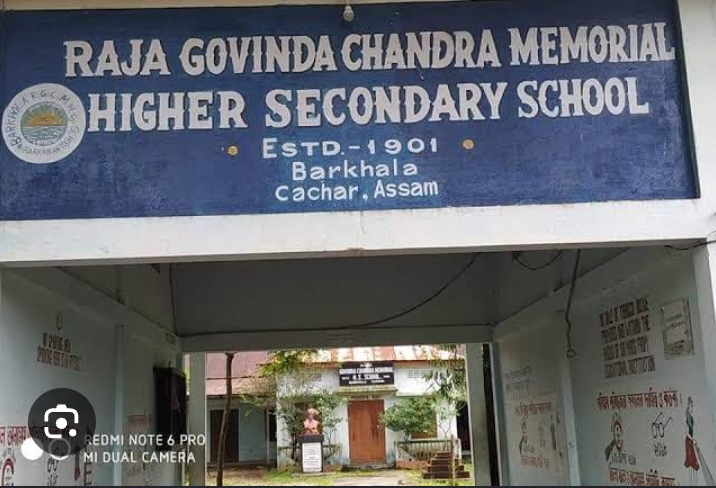
His son, Runu Barman, far more interested in mischief and adventure than in academic pursuits, his daughter, Bijuli, two or three years my senior at Raja School, assured having casted her vote in my favor when I contested for the post of music secretary in the school election.
Among doctor’s close neighbors were Ram Mohanbabu, and Manindrababu, both of whom we came to know well. Sometimes we were sent by our father to ask Ram Mohanbabu to see him on some personal matters. Such errands were a great fun for us as it afforded us with a pleasure trip of crossing the river on foot to reach the destination and spend some time in the village.
Manindrababu was known to be a communist. As children, we scarcely understood what being a communist meant, but stories got about that he and his family had to spend several years as fugitives in the Barail hills after independence being pursued by the police. In reality, he was one of the gentlest and most courteous men one could meet. He devoted much of his time to experimenting with vegetables and cash crops on the fertile banks of the Jatinga.
His communism, as far as we could discern, consisted chiefly in subscribing to the glossy Soviet Land, copies of which he would freely pass on to anyone who showed an interest for the stories and for the pictures in them. There was little about him that caused fear, despite the aura of political suspicion that surrounded his name.
His son, Dipta-da, a close friend of one of our elder brothers, was a cheerful and energetic young man who frequently visited our house. After returning from military service, he devoted considerable time to social activism, sports and to music. During our school days, we often sang a Dimasa version of one of Kazi Nazrul Islam’s patriotic song—‘Durgam giri kantar maru duster parabar…, introduced to the students through his efforts. The lyric in Dimasa reads thus: lamglay fua, hurglay fua Di wai gabeng dong/ laima glayma hurni/ dflayasa grukala…’
During the Language Movement of 1961, Dipta-da volunteered to organise demonstrations in and around the village along with Rajkumar-da and Dr. Rakshanath Deb. His sister, too, was familiar to our family and often visited our house in the company of our sisters.
The residential neighborhood surrounding the temple of Ranchandi was home to many cultured and respected families. The men were held in high regard in public life, while the young women, capable of weaving clothes on handloom were accomplished in music and dance, regularly played leading roles in school and community functions.
Though time has dimmed many of our memories, we still remember the parental home of Nirupama-di and Anupama-di, a family well known throughout the Barkhola area. Their brother, Nishikanta Barman, maintained close ties with our family.
In the Cachar plains, there was a popular saying that the most cherished and respected housewives in the hills of Maibang, Haflong and other places were often daughters of Cachar plains ( local sayings had it that “Maibang’s mati and Khaspurer beti had a good match” ) —Barkhola, Bijaypur, Dalu or Thaligram, Jaypur, Rajabazar, Nagar, Amaranagar, Damcherra, Dhali– all were, however, within the ambit of Khaspur kingdom. Nirupama-di was a shining example of this tradition of sending the lass of Khaspur to the soil of Maibang. She became the gracious mistress of the household of none other than the education minister of the state. Of course, in the village she was just a girl loved by all with nothing unusual in her behavior. Her husband, Sri JB Hagjer used to visit the village as a groom, not as minister. He was respectful of the jaminder Jatinbabu (the author’s father) whom he used to give a courtesy visit during his tour to the village. Our brothers (Bhaskar Pratim, Ajay) reported that in one of their visits to the capital were treated by the minister most cordially as sala kutum (brother in law) as he preferred to address the lads from Cachar that way.
A journey through the hills of Barail, irrespective of whether one is a tribal or a Bengali, whether a Hindu or Muslim– would be marked by a warm reception from many such beloved sisters from Cachar plains. They had adorned the households of Dimasa families in the hills with their warmth and generosity, winning affection wherever they lived. Their presence stood as a living bond between the plains and the hills, linking communities through kinship, affection, and shared lives.
Perhaps the most beloved figure to us in Bijaypur was Noba Bhagina (nephew), although considerably older than us schoolboys, an employee with the district administration, he would invariably address us as Mama with unfailing respect. We never failed to visit his house as and when we crossed the river, though his mother our Didi in her old age could hardly recognize us except that we were from her own kutum bari across the river.
The bhagna was a frequent visitor to our house, drawn by his love of music, much of which he learned from listening to our father. He sang Rabindrasangeet remarkably well and became especially known for his rendition of ‘ei monihar amay nahi saje’ during the Tagore Centenary celebrations of 1961. He also taught the song to many girls in the villages, thereby helping to spread a love of Rabindrasangeet among the younger generation. He called our father Dadamashay and mother Didima, and was loved deeply by them.
Among the most sociable and respected and enlightened gentlemen of Bijaypur was Gopendra Barman, whose distinguished family shared a close bond with ours. I still fondly remember his son Manabendra, a truant classmate of mine, who introduced me to several popular Bengali songs sung by Lata Mangeskar, Hemanta Mukherjee. One such song was a Bengali hit ‘keno gele parabase bolo bandhua’—a difficult number for its intricate rhythm. Manabendra patiently helped me master its taal, tapping it out on our classroom desk as I struggled to keep pace.
His elder brother, Samar-da, was an accomplished musician who often played a hit songs of Shyamal Mitra ‘ki name deke bolobo tomake’ on the Hawaiian guitar at school functions. Their sisters, Sukla and her elder sibling, were both affectionate and talented; it was painful to recall that, in one of our visits to his house, the old man had showed the picture of his elder daughter died an untimely death with tears in his eyes. Thanks God, he did not outlive to see his younger daughter who too passed away long before her time.
No account of Raja school’s cultural life would be complete without mentioning Alaka and Madhuri-di, and a score of artists from Bijaypur, whose graceful dance performances were indispensable to our annual programs. As a school boy I still remember viewing their dance featuring Tagore’s ‘nadi apan bege pagal para ami stabdha chapar taru’ with our sister (Jaya) offering the vocal support.