
Barak UpdatesHappeningsBreaking NewsFeature Story
Carrying the Torch : Dasharupak’s Aaijo Aaindhair marks its 50th staging, reviewed by Shanku Sharma
//Shanku Sharma//
To carry forward the legacy of a celebrated play is no small feat. It demands not just fidelity to the spirit of the work, but also the creative courage to keep it alive, relevant, and breathing. On the evening of August 10 at Banga Bhawan, Silchar, Dasharupak Cultural Organisation achieved precisely that. With its landmark 50th staging of Aaijo Aaindhair, the group delivered a performance that was at once a tribute to its own past and a reaffirmation of theatre’s enduring power to stir the soul.
Written and directed by Chitrabhanu Bhowmik, Aaijo Aaindhair is no ordinary production. Over time, it has become a touchstone for socially committed theatre in the Barak Valley—an unflinching portrayal of poverty, injustice, and the unyielding human spirit. Its 50th performance was a celebration, yes, but it was also a reminder: some stories remain as urgent today as they were on the day of their first telling.

A Flood of Despair, a Flicker of Hope
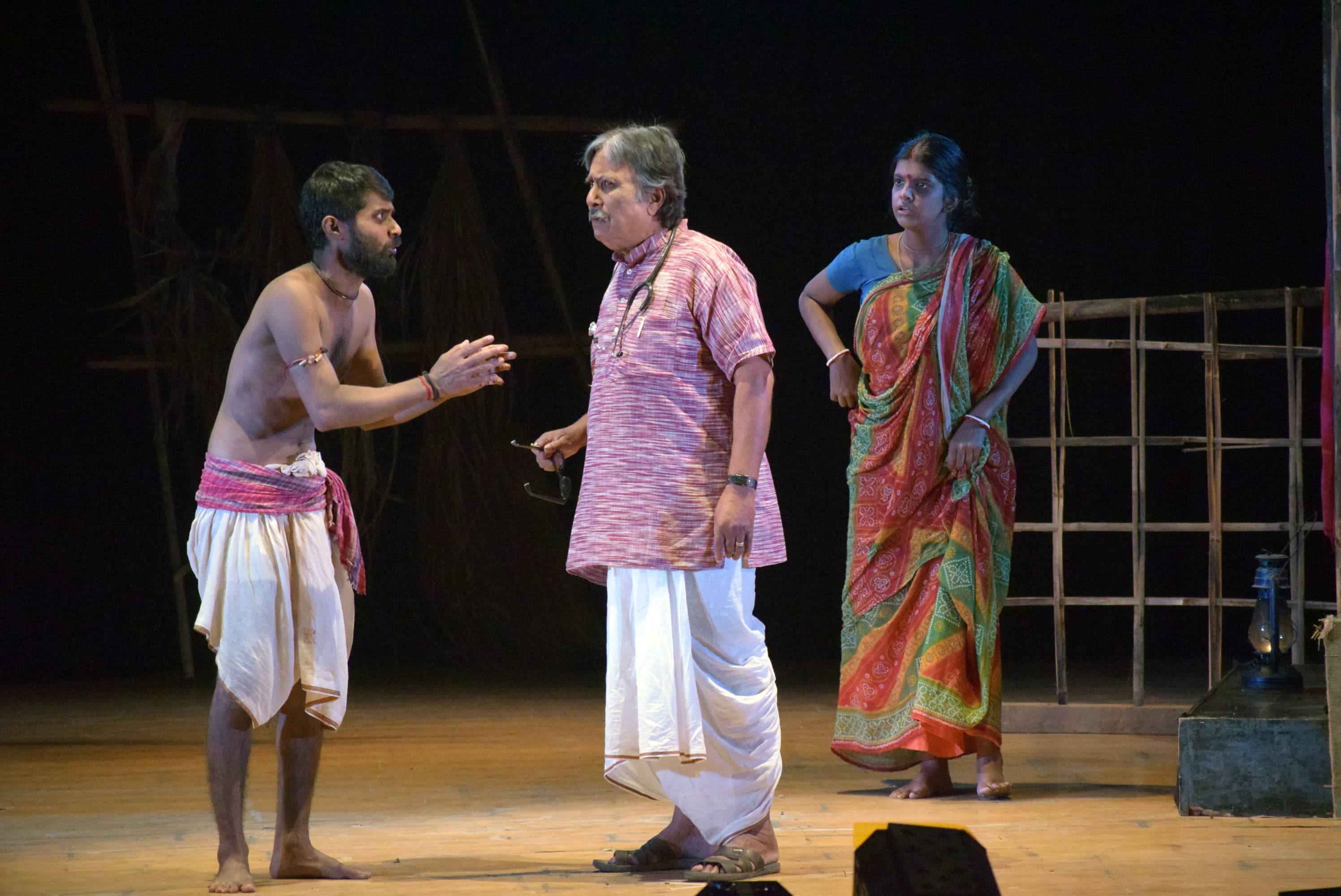
Set against the backdrop of a devastating flood, the play chronicles the plight of an impoverished family trapped by both nature’s fury and society’s cruelty. Rabi (played with gravitas by Shubhrendu Chakraborty) and Nayana (Ritteka Dey, luminous in her portrayal) cling to their gravely ill child (played by Agrima Chanda), even as floodwaters seep into their home. Relocation is impossible. Survival itself seems uncertain.
But the flood is not the only antagonist. The village embankment has been deliberately broken by miscreants, submerging the community. And amidst this watery prison lurks Rasendra (Bidhan Choudhury, in a tour de force of villainy), a wealthy, predatory landlord whose lust for Nayana knows no bounds. His performance was chilling—dripping with entitlement, greed, and moral rot.

The suffering is unrelenting, yet hope persists—a fragile, stubborn hope, much like in the old adage: Is Raat Ki Subha Nahin (“The night may be long, but morning will come”).
The flashback transports us to the cherished days of Rabi’s past, a time filled with hope, warmth, and happiness for her family.
Characters That Stay With You
If Aaijo Aaindhair is Bhowmik’s magnum opus, it is because of how fully its characters inhabit their world. Ashish Bhowmik, in the relatively brief role of the village doctor, left a mark that was disproportionate to his stage time. His refusal to accept fees from Rabi and Nayana, and his confession about losing his own child due to the callousness of an indifferent medical system, was deeply affecting. His delivery made the audience ache.
In contrast, Bhowmik himself, in a turn as Hadu—the village’s ganja-addict—brought moments of levity. Much like the gravediggers in Hamlet, Hadu’s comic relief offered a momentary reprieve from the tragedy. Yet, in the final act, he pivoted from humor to heartbreaking urgency, calling for help that would never arrive—a tonal shift executed with masterly precision.
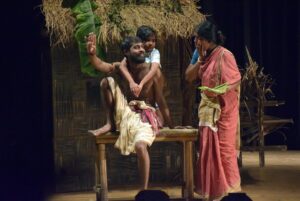
Hadu’s wife, Joba (played by Keya Roy Dutta), leads an unhappy life because of his (Hadu) irresponsible behaviour, indifference towards life, and neglect of his duties. Jayanta Prakash Bhattacharjee delivered a brilliant performance as a suffering villager.
Madhab’s (Santosh Chakraborty) quest for a log of wood to build a boat remained fruitless. Although he had promised to help, he was unable to do so.
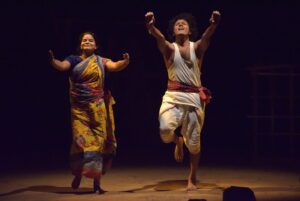
Mishmita Nath Samajpati’s duet dance performance transported the audience back to the cherished days of the past.
Realism Woven Into Every Element
Part of what makes Aaijo Aaindhair so powerful is its unflinching realism. The dialogues are rooted in the rhythms of the local dialect, the costumes bear the wear of poverty, and the set evokes the damp, muddy claustrophobia of flood-ravaged homes. The original stage design by Bibek Dasgupta, realised for this production by Ashok Sinha Rajkumar and Kashi Biswanath Das, was strikingly authentic. The lighting, first conceptualised by Subhash Choudhury and adapted for this performance by Debojyoti Roy, shifted seamlessly from the dim gloom of night to the bleakness of waterlogged dawn.
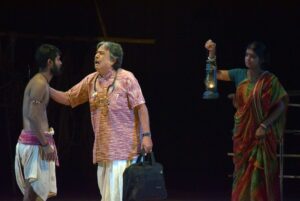
Special mention must go to Avik Sengupta’s make-up artistry, which heightened the realism without ever descending into theatrical excess. Mud-streaked skin, tired eyes, and weathered faces told stories even before the actors spoke a word.
The Heart of the Matter
At its core, Aaijo Aaindhair is not merely a story about one family’s suffering. It is a portrait of a community’s collective despair—a mirror held up to the systemic neglect and exploitation faced by the rural poor. Miscreants can sabotage embankments with impunity; the wealthy can prey upon the vulnerable without consequence; basic medical care remains out of reach for those who cannot pay.
And yet, it is also a story about resilience. Rabi and Nayana, despite their powerlessness, never abandon hope for their child’s survival. Their endurance becomes the quiet rebellion that threads through the tragedy.
A Legacy Sustained
That this was the 50th performance is itself remarkable. In an era when many theatre productions struggle to see even a handful of stagings, Aaijo Aaindhair has not only endured but deepened its relevance. Credit for this must go to Chitrabhanu Bhowmik—a director, writer, and actor whose vision has kept the production vibrant over the years. As you watch him on stage, you sense that he is not simply performing a role; he is carrying a legacy, one that he has both inherited and built.
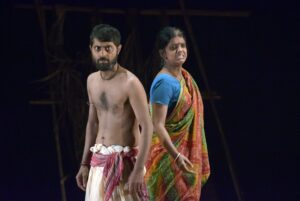
“Chitrabhanu Bhowmik is Chitrabhanu Bhowmik—the only one of his kind,” as one might put it.
In the end, the 50th staging of Aaijo Aaindhair was more than a performance. It was a gathering of memories, struggles, and hopes—past and present—woven together under the dim lights of Banga Bhawan. The applause that followed was not just for the cast and crew, but for the very idea of theatre that refuses to fade, for stories that must be told again and again until their truth is no longer ignored.