
Barak UpdatesHappeningsBreaking News
The Saga of a Dimasa village (Part 1), written by Sanjib Deblaskar
//Sanjib Deblaskar//
As a visitor to the village after half of a century, reflecting on the steady migration of people from the countryside to the towns and cities, one has feeling of an old villager who would often warn us: “One should never abandon one’s village. It wounds the village’s heart.” He would then add, “an offended village has its own ways of taking revenge like it’s doing now to this one.”
Pointing towards the Jatinga, he would say, “Just look at this river. Once it was beautiful beyond words—its waters sweet and clear, its banks clothed in luxuriant greenery. We have heard of the great flood of thirty six Bangla (corresponding to 1929 AD in Christian era), but that was an exceptional event, a calamity shared by all. Barring it, for generations the river nurtured and protected its children. It sustained their fields, quenched their thirst, and enriched their lives.
“But now things have changed, the children have drifted away from the life-giving river. Drawn by the attractions of distant towns and cities, they have abandoned the villages that raised them. And the river, too, seems to have turned her face away from her children. Her waters have receded, her banks have become uncertain, and she no longer embraces the land as she once did. It is as though she feels the pain of abandonment and, in silent sorrow, has withdrawn her blessings.”
Seeing the deserted spectacle of the Dimasa village the present author is tended to feel the Dimasas must have forgotten that, they are the ‘children of di’—i.e., water. The very name of the community bears testimony to their intimate bond with rivers and streams, the perennial source of Di. For centuries, by the blessings of Ranachandi Mai, their forefathers traversed hills and valleys, enduring hardships and uncertainties, until they found shelter on the banks of mother Jatinga.
This river springs from the heartland of the ancient Dimasa kingdom, cradled in the lap of the Barail Hills. From Maibang to Hawarma, and from Hawarma to Bijaypur and elsewhere, it was a remarkable journey. They did not travel alone. Along the way they embraced all the peoples they encountered with affection and fellowship, sharing joys and sorrows, and their festivities with all.
The river nourished the people, and they, in turn, nurtured a way of life rooted in harmony with the land and with their neighbors. That is why it pains one to see the villages emptying and the old bonds weakening. A people who forget their rivers, their villages, and the blessings that guided their journey risk forgetting themselves.
“See how the Di kong (river) has shrunk and lost its vitality. Its two banks have no fixed boundaries anymore. Today the riverbed is on one side, tomorrow on another—moving entirely according to its own fancy.
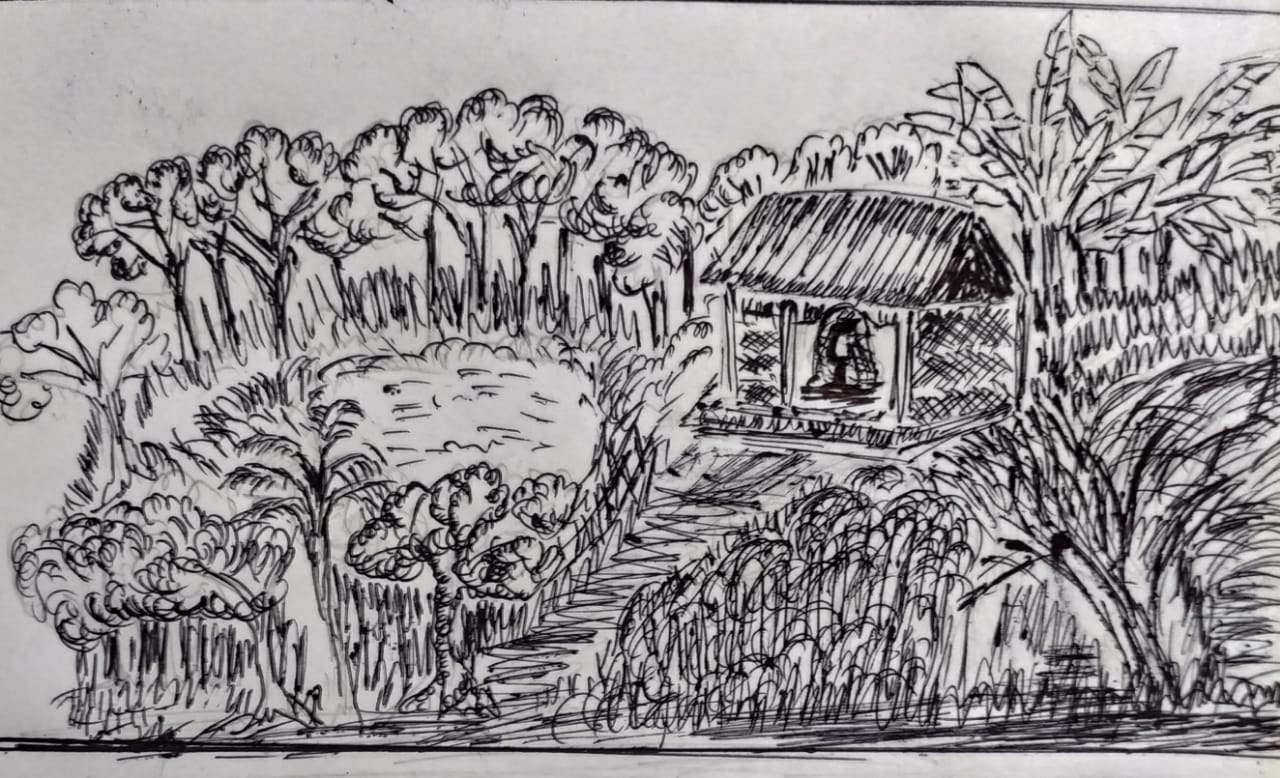
Even mother Ranchandi seems to have turned her face away. She used to dwell in peace under the shade of the wild bong fang, phraphang, thaiju (trees, peepal, mango trees), flower giving jarul and kala-uzha. Then, one by one, the people of the Kachari settlement began to desert the village lured by distant call. They moved away to Haflong, Guwahati, Diphu, and Silchar and lands beyond that, even abroad. Once a year some among them come to offer a platter of jika (rice) along with fruits– thailik, hontra, thaidima, thaiju (plum), thaiflung (kathal) and colourful khim (flower) like jaosa ( jaba), marmi (madhabi) to the Goddess and dau, dauplumdu, daopri, burun-jala (bird, duck, pigeon, goat) for sacrifice in her puja and of course, some coins in the thali; the well to dos, however, offer gajju, gupphu (gold and silver). Gradually a temple built, and money accumulated in the deity’s coffer. You all thought that mother Ranachandi must be very pleased with that. But completely wrong you are. She never craves for wealth. She was happy in the century old thatched cottage, covering herself in the humble wooden kurshi with a piece of linen preventing all, except the Bengali hojai (priest) to look at her only at the time of puja.
One can hear the wailing of the deity at the dead of night if one has the ears to hear it.
( Ranchandi temple, Bijaypur century ago– conceived imaginatively by Sanjoy Deblaskar)