

India & World UpdatesHappeningsBreaking NewsFeature Story
Religion, Festival and Market: Spirituality versus Commerce, written by Dr. Manoj Kumar Paul
✍️ Dr. Manoj Kumar Paul
(Former Principal, Women’s College, Silchar)
Throughout human history, religion has played a profound role. On one hand, it offers spiritual peace; on the other, it strengthens social unity and cohesion. Yet, in modern times, religious festivals have become more than spaces for spirituality—they are now vast commercial enterprises. Pujas, rituals, fairs, and pilgrimages today conceal within them enormous economic infrastructures, advertising networks, product promotions, and market-driven motivation
1. Religion and the Market: An Ancient Connection
The link between religion and commerce is not new. In ancient India, fairs and markets would spring up around pilgrimages and yajnas; local craftsmen, potters, flower sellers, and vendors of offerings earned their livelihood through these events. However, in the twenty-first century, this relationship has taken on a new dimension. Religious festivals today involve transactions worth billions, corporate sponsorships, media campaigns, and economic competition. The purity of faith now merges with the strategic calculations of the market.
2. The Economics of Festivals
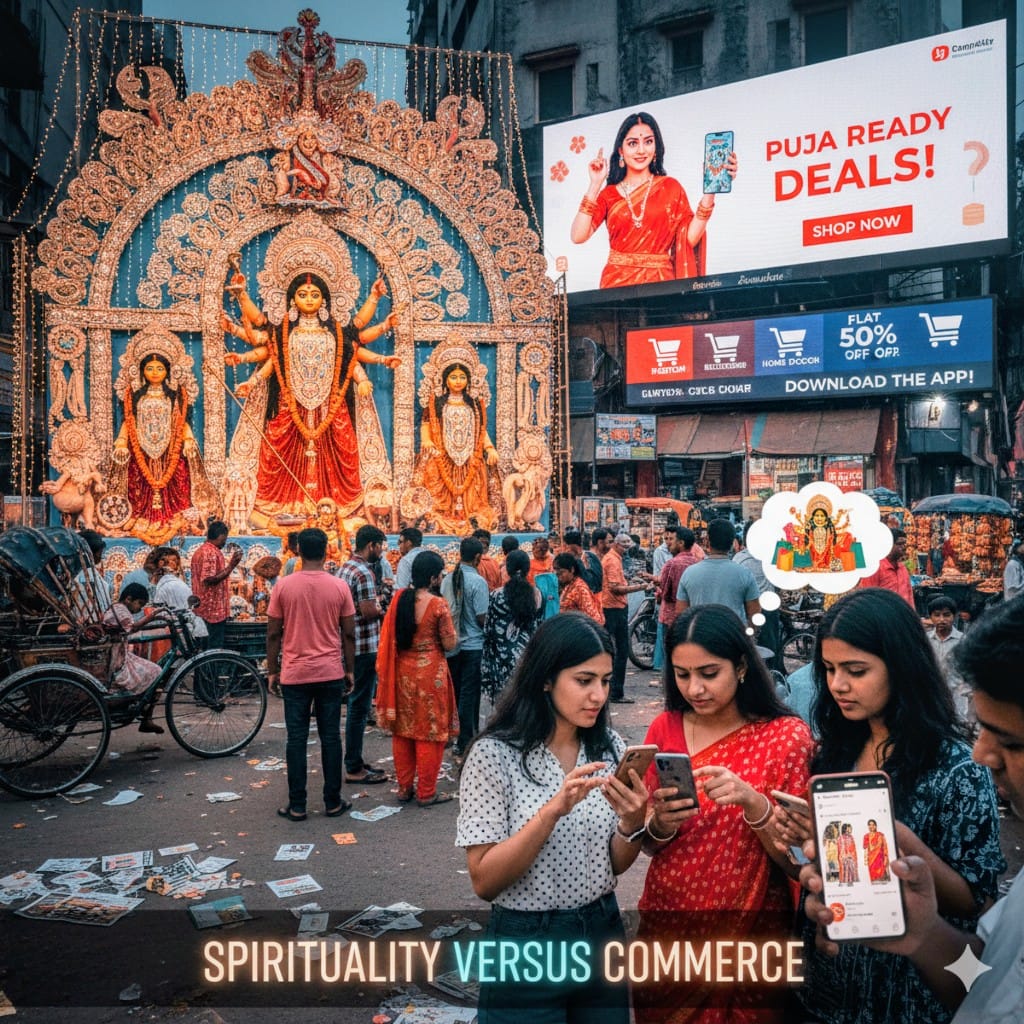
The Bengali Durga Puja is the most vivid example of this transformation. What was once a private, family ritual has evolved into a grand social and economic festival. The budgets of major community pujas often cross several crores of rupees. From lighting and decoration to idols, garments, cosmetics, and food—the entire economic wheel spins faster during the festive season.
Thousands of people are directly involved—idol-makers, carpenters, electricians, florists, weavers, transporters, and even the humble tea seller. In one sense, Durga Puja and Kali Puja have become festivals of employment as much as devotion. Yet behind this vibrancy lurk competition, ostentation, and spectacle. The goddess’s worship is often overshadowed by the scale of the pandal, the lighting, and the sponsorship banners.
3. Commodification of Religion
In our times, religion itself has become a kind of “brand.” Temples now offer “VIP darshan,” “special prasad packages,” and online puja services—all available at a price. Merit and blessings have gone digital: “online Darshan” and “virtual Aarti” have turned devotion into a purchasable commodity.
The media’s involvement in religious events has also acquired a commercial face. Live telecasts of Yajnas, temple rituals streamed on YouTube, and devotional content monetized through advertisements—these are now lucrative industries. As a result, religious sentiment is steadily losing its sacred essence, absorbed instead into networks of corporate investment.
4. Religious Tourism and the National Economy
Religious events and pilgrimages today form a vital part of the tourism industry. The Ratha Yatra of Puri, the Kumbh Mela, Vaishnava circuits, the Amarnath Yatra, and the temple festivals of South India—each draws millions of participants. Their travel, lodging, food, souvenirs, and transport together constitute a massive religious economy.
The Government of India has even launched projects like “Spiritual Circuits” to institutionalize religious tourism. This initiative strengthens the link between religion and economy but also accelerates the commercialization of faith.
5. Festivals in the Digital Age: The Rise of Online Commerce
Today, religious celebrations extend far beyond temples or community grounds—they have entered our mobile screens. E-commerce platforms like Amazon, Flipkart, Myntra, Meesho, and Ajio turn every festival into a shopping season. Durga Puja, Diwali, Eid, Holi, Christmas or New Year—each comes with online campaigns such as “Great Indian Festival,” “Big Billion Days,” “Pujo Fashion Edit,” “Diwali Dhamaka Offer,” “Holi Hungama Sale,” or “Christmas/New Year Bonanza.”

These platforms skillfully exploit the emotional appeal of festivals to reach consumers’ psychology. People associate celebrations with new clothes, gifts, and décor—and discounts with happiness. Thus devotion and indulgence fuse together. Religious events are transformed into psychological festivals of consumption.
6. Marketing Strategies of the Festival Economy
E-commerce companies now design special strategies around religious festivals:
Exclusive categories for festive wear, jewelry, and accessories during Puja or Eid.
“Festive Combo Offers” on electronics during Diwali.
Christmas “Secret Santa Deals” and gift hampers.
Instalment-based sales like “Zero Interest EMI,” and “Buy Now, Pay Later.”
Through such promotions, religious emotion is used to push consumers toward materialism. The boundary between faith and consumption is blurring; religion becomes merely an occasion for sale.
7. Crisis of the Local Market
This expansion of online commerce has created a serious challenge for local businesses. Previously, marketplaces would bustle before Durga Puja—clothes, sweets, toys, and ornaments flying off the shelves. Now, many consumers simply order everything through mobile apps.
What once revitalized local economies has now become a source of profit for corporate giants. Small artisans and vendors cannot compete with the massive discounts, logistics, and advertising power of online platforms. Religion-based trade, once local and communal, has been absorbed by multinational capital.
8. The Kumbh Mela: From Faith to Global Commerce
The recent Prayagraj Kumbh Mela (2025) exemplifies how religion has turned into a vast commercial and tourism network. According to some estimates, over 400 million people participated, with investments running into several thousand crores of rupees.

The event is not merely religious—it is now a global brand, attracting devotees, entrepreneurs, journalists, foreign tourists, and corporations alike.
Economic Infrastructure: A temporary city of tents, electricity, roads, sanitation, health services, and digital connectivity—every sector becomes a marketplace.
Religious Tourism and Corporate Entry: Luxury facilities such as helicopter rides, Ganga Aarti viewpoints, and “Kumbh Tent City” packages are all commercialized experiences.
Local Employment: Tent builders, boatmen, food vendors, and artisans find short-term livelihoods—though seasonal and unstable.
Digital Kumbh: The 2025 event also introduced virtual rituals, online donations, and religious e-commerce—turning spiritual experience into digital consumption.
Spirituality vs. Spectacle: Media broadcasts, hoardings, and corporate-sponsored tents convert faith into visual entertainment.
9. Social and Ethical Implications
This trend of religious commercialism exerts a dual influence on society. On the positive side, digital platforms have opened avenues for small entrepreneurs, home-based producers, and women artisans to reach wider markets. Religious festivals have thus become sources of digital livelihood for many.
Yet, the negative side is significant. Under the banner of religion, consumerism and display culture are spreading rapidly. Durga Puja now implies a new smartphone; Eid, branded fashion; Diwali, a television or refrigerator. The spiritual essence of faith is dimmed by the glare of consumption.
10. Religion as Commerce versus the Ethic of Devotion
The purpose of religion is self-purification and social welfare. But when religious events become tools of commerce, they lose their moral centre. Devotion gives way to display; compassion to competition. Behind the worship of the divine unfolds a marketplace—whose pandal is bigger, whose budget higher, whose sponsor richer.
Ordinary people too have turned more toward social exhibition than spiritual introspection. Consequently, the moral aims of religion—compassion, restraint, and inner peace—are drowned in the clamor of trade.
Yet, the synthesis of religion and commerce need not be wholly unacceptable, if guided by ethics and balance. When festivals support local crafts, artisans, and tourism, they can uplift society. But when corporate greed and advertising-driven consumerism exploit religious emotion, they erode society’s moral fabric.
When religion belongs to the people, it becomes a festival of devotion; when it belongs to the market, it becomes a festival of profit.
The challenge of the future lies in maintaining this balance. We must nurture a culture where festivals celebrate not only consumption but also conscience—where joy coexists with spiritual and social awareness.
Religious festivals were meant to unite people, to teach peace, morality, and compassion. But when they become commodities in the marketplace, religion ceases to be the path to liberation and becomes instead a product displayed for sale.
Still, one may hope: someday, amid the noise of commerce, the true essence of faith—humanity, restraint, and empathy—will be rediscovered. And then, perhaps, the union of religion and economy will lead not to greed, but to a new dawn of social enlightenment.