
India & World UpdatesHappeningsBreaking NewsFeature Story
When Power Kidnaps Sovereignty: America’s Final Lesson in Democratic Hypocrisy, written by Dr. Manoj Kumar Paul
//Dr. Manoj Kumar Paul//
(Former Principal, Women’s College, Silchar)
The United States has carried out an act that may come to define one of the darkest chapters of contemporary international relations. In an unprecedented military operation, U.S. armed forces allegedly entered Venezuelan territory, stormed the private residence of the country’s sitting president, Nicolas Maduro, restrained him with bound hands and covered eyes, and forcibly transported him to the United States to face criminal proceedings under American law. As no authoritative denial has contradicted this report, circulating at international and national level—this incident marks not merely a diplomatic rupture, but a profound assault on the foundations of international order.
This was not a routine law-enforcement action. It was not an extradition conducted through legal treaties. It was not an arrest sanctioned by any international judicial authority. It was a military abduction of a head of state from the soil of a sovereign nation. To call it anything less is to dilute the gravity of what has occurred.
For decades, the United States has positioned itself as the self-appointed guardian and global instructor of democracy. It has lectured nations across Asia, Africa, Latin America, and the Middle East on constitutional governance, electoral legitimacy, the rule of law, and civil liberties. Governments have been praised, sanctioned, destabilized, or supported depending on how closely they aligned with Washington’s interpretation of democratic acceptability. Yet democracy, stripped to its most basic principle, rests upon one non-negotiable foundation: sovereignty. Without sovereignty, democracy is an illusion—an exercise permitted only so long as it does not conflict with external power.
By forcibly removing the elected president of Venezuela without the consent of the Venezuelan state, without authorization from the United Nations Security Council, and without any recognized international judicial mandate, the United States has violated this foundational principle. It has demonstrated, with alarming clarity, that its commitment to democracy ends where its geopolitical interests begin.
Under Article 2(4) of the United Nations Charter, all member states are prohibited from using force against the territorial integrity or political independence of any other state. This prohibition is not symbolic; it is the cornerstone of the post-World War II international legal system. The only recognized exceptions are self-defense against an armed attack or actions explicitly authorized by the UN Security Council. Neither condition applies here. Venezuela did not attack the United States. No UN mandate sanctioned military intervention. The legal conclusion is unavoidable: this operation constitutes a prima facie violation of international law.
The United States has attempted to justify its actions by pointing to long-standing criminal indictments against President Maduro, including allegations related to narcotics trafficking and corruption. Even if one were to assume, for the sake of argument, the validity of these accusations, they still do not provide legal justification for military intervention. Domestic indictments issued by a national court do not confer universal jurisdiction over foreign leaders governing sovereign states. If such logic were accepted, the international system would descend into chaos, where powerful nations routinely capture foreign officials they deem undesirable, under the pretext of law enforcement.
This is precisely why international law insists on multilateral mechanisms. The International Criminal Court exists for a reason. Extradition treaties exist for a reason. Diplomatic engagement exists for a reason. To bypass all of these mechanisms in favour of armed force is not efficiency—it is lawlessness disguised as authority.
At this juncture, the moral contradiction becomes impossible to ignore, particularly when viewed through the lens of American political rhetoric. The very leader under whose command this operation reportedly took place—Donald Trump—has repeatedly proclaimed himself a peacemaker. He has publicly claimed that he “stopped wars in many countries,” portrayed himself as uniquely capable of preventing global conflict, and even suggested that he deserved the Nobel Peace Prize for his role in maintaining international stability.
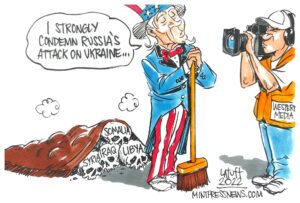
Such claims, when placed alongside the image of a foreign president blindfolded and bound by U.S. forces, collapse under their own weight.
Peace is not achieved by violating sovereignty. War is not prevented by militarized abduction. A Nobel Peace Prize is not earned by turning international law into an instrument of selective punishment. The grotesque contrast between Trump’s self-image as a global peacemaker and the reality of armed intervention against an independent nation exposes the hollowness of such rhetoric. One cannot claim the mantle of peace while normalizing acts that bring the world closer to lawless confrontation.
What makes this episode particularly dangerous is the precedent it establishes. If the world’s most powerful military can unilaterally abduct a sitting president from his own country, then no leader of a weaker nation is secure. Sovereignty becomes conditional. Independence becomes provisional. International law becomes optional. Such a world is not governed by rules, but by hierarchies of power, where might determines right and legality follows force rather than restraining it.
Supporters of the U.S. action argue that President Maduro’s leadership has been widely criticized, that Venezuela has suffered economic collapse, and that democratic norms within the country have eroded. These criticisms may be debated, analyzed, and even condemned. But none of them grant an external power the authority to decide Venezuela’s political future through military coercion. The legitimacy or illegitimacy of a government must be determined by its people, not by foreign commandos operating under another nation’s flag.
Democracy cannot be delivered through handcuffs and blindfolds. Political reform cannot be imposed by helicopters and shock tactics. History has repeatedly shown that externally enforced regime change rarely produces democracy; far more often, it produces instability, violence, and prolonged suffering for ordinary citizens. Latin America, in particular, bears deep scars from such interventions—scars left by coups, proxy wars, and covert operations justified in the language of freedom but executed in the service of strategic interests.
The moral hypocrisy at the heart of this act is stark. A nation that condemns authoritarian practices has employed authoritarian methods. A state that claims to defend the rule of law has openly bypassed it. A government that demands accountability from others has acted without submitting itself to any international scrutiny. This is not democratic leadership; it is imperial arrogance wrapped in moral language.
The geopolitical implications are equally troubling. Smaller states across the Global South are now forced to confront a chilling reality: international law may not protect them if their policies conflict with the interests of powerful nations. Diplomatic disagreements may no longer remain diplomatic. Legal disputes may no longer be resolved through courts. The message—whether intended or not—is unmistakable: compliance ensures safety; defiance invites force.
Equally alarming is the further erosion of multilateral institutions. The United Nations, already weakened by selective adherence and geopolitical vetoes, is rendered increasingly irrelevant when major powers act unilaterally. Each such action chips away at the credibility of collective security and reinforces global cynicism about the very idea of a rules-based order.
Ultimately, it is the people of Venezuela who will bear the heaviest burden. Military incursions, political shock, and the destabilization of state authority rarely end with their stated objectives. They ripple outward—disrupting economies, fracturing societies, and deepening humanitarian crises. Any action taken in the name of democracy that results in greater suffering must be morally interrogated, not celebrated.
The international community must respond with clarity and resolve. Silence would normalize aggression. Acceptance would dismantle decades of legal progress. Selective outrage would confirm the worst fears of smaller nations—that principles are invoked only when convenient. If democracy is to retain meaning beyond slogans, then sovereignty must be defended consistently, not selectively.
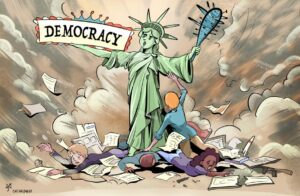
The United States must be held to the same standards it demands of others. Power does not confer moral exemption. Military strength does not substitute for legal legitimacy. And peace is not declared by those who wield force, but by those who restrain it.
In the end, the question confronting the world is stark and unavoidable: Will the international order be governed by law, or by force?
The answer will define not only Venezuela’s future, but the future of global democracy itself.