
Barak UpdatesHappeningsBreaking News
Risk Reduction: Workshop on Earth Observation Data and AI in Assam University
way2barak Jan 11: Assam University’s Disaster Risk Reduction (DRR) Club Marks Its Journey with National-Level Workshop on Integration of Earth Observation Data and AI for Disaster Science
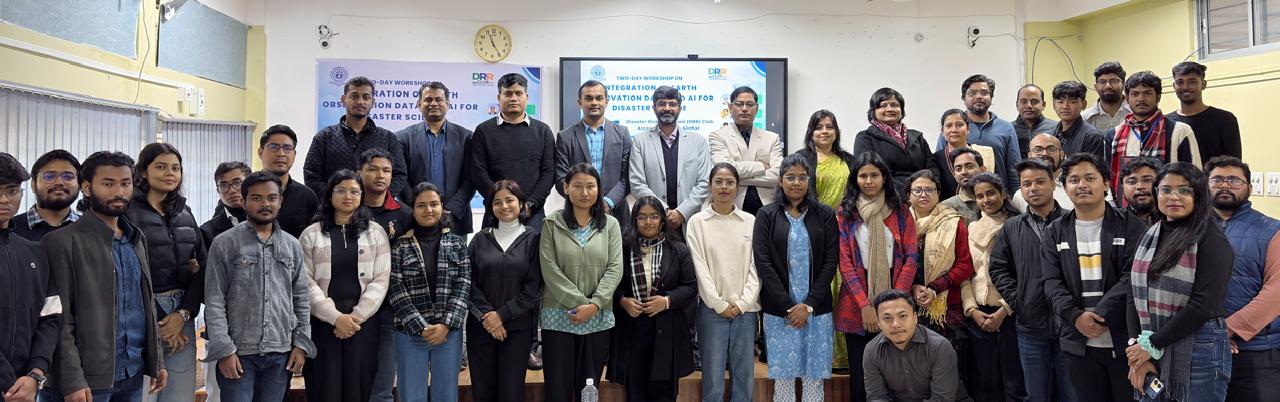
Assam University, Silchar has taken a significant step towards strengthening disaster preparedness and mitigation by establishing a Disaster Risk Reduction (DRR) Club under the leadership of Vice-Chancellor Prof. Rajive Mohan Pant. The initiative was spearheaded by Dr. Aditi Nath, Assistant Professor, Department of Social Work, and Prof. Arun Jyoti Nath, Department of Ecology and Environmental Science, Assam University, with support from the National Institute of Disaster Management (NIDM). Marking the beginning of its journey, the DRR Club organised a Two-Day Workshop on “Integration of Earth Observation Data and AI for Disaster Science” on 9-10 January 2026 at the Seminar Hall of the Department of Computer Science and Engineering, Assam University, Silchar. The workshop was conducted with the collaboration and financial support of the IEEE GRSS Kolkata Chapter, the Asia Pacific Neural Network Society, and Reliance Retail. The workshop aimed to engage young minds including students, research scholars, and young professionals in disaster mitigation and risk reduction. A total of 40 participants were selected from diverse disciplines such as Computer Science, Ecology and Environmental Science, Economics, Commerce, Geology and Social Sciences, representing institutions including Assam University, Gurucharan University, Adamas University, Birla Institute of Technology, North Eastern Regional Institute of Management, DCRNSD and Cotton University. The inaugural session commenced with an address by Prof. Arun Jyoti Nath, Chairperson of the DRR Club, who highlighted the background of the club and emphasized the importance of disaster preparedness and mitigation through the integration of Earth Observation data and Artificial Intelligence. This was followed by an address from Dr. Deepak Kumar, IIIT Bhubaneswar, who discussed various disaster management initiatives undertaken by IEEE and outlined opportunities for future collaboration through IEEE memberships. Prof. Piyush Pandey, Director, IQAC and Dean, Research and Consultancy, Assam University, who was chaired the inaugural session, praised the initiative and stressed the importance of human-centric disaster management. Highlighting the role of youth in building resilient communities, he referred to India’s cultural ethos of collective well-being, emphasising the principle of “Sarve Bhavantu Sukhinah.” The inaugural session concluded with a vote of thanks by the Programme Coordinator, Dr. Arnab Paul, Assistant Professor, Department of Computer Science and Engineering. The lecture series featured experts from premier institutions, integrating perspectives from social sciences, ecology, and AI-driven approaches. Dr. Shivani Chauhan Barooah from the School of Social Work, Tata Institute of Social Sciences, Guwahati, spoke on community response patterns and capacities, covering early warning systems, disaster coping mechanisms, displacement, and long-term rehabilitation. Dr. Amitabha Nath from North-Eastern Hill University, Shillong, discussed building resilient communities through Earth Observation and AI-enabled early warning and rapid assessment systems. Dr. Swalpa Kumar Roy from Tezpur University delivered a lecture on Self-Supervised Learning for Geospatial Foundation Models. The first day concluded with a hands-on session by Dr. Amitabha Nath, demonstrating Soil Organic Carbon modelling techniques in ArcGIS.
The second day began with a lecture by Prof. Ashish Ghosh, Director, IIIT Bhubaneswar, on AI for Disaster Science, followed by Prof. Susmita Ghosh from Jadavpur University, who spoke on Explainable AI in Disaster Science. Dr. Somnath Mukhopadhyay, Department of Computer Science and Engineering, Assam University, presented on Fuzzy Rule-Based Early Warning Systems for Landslides and Floods. This was followed by a hands-on session on NDVI mapping using QGIS and machine learning techniques, assisted by his research fellows.
The workshop concluded with feedback from participants and remarks by Prof. Gangabhushan M. Molankal, Department of Social Work, Assam University, who lauded the initiative and emphasised the importance of safeguarding human lives through effective governance and disaster preparedness. The workshop concluded with closing remarks by the host, Dr. Aditi Nath.