
Barak UpdatesHappeningsBreaking News
District Administration observes National Press Day 2025 with strong message on truth and credibility
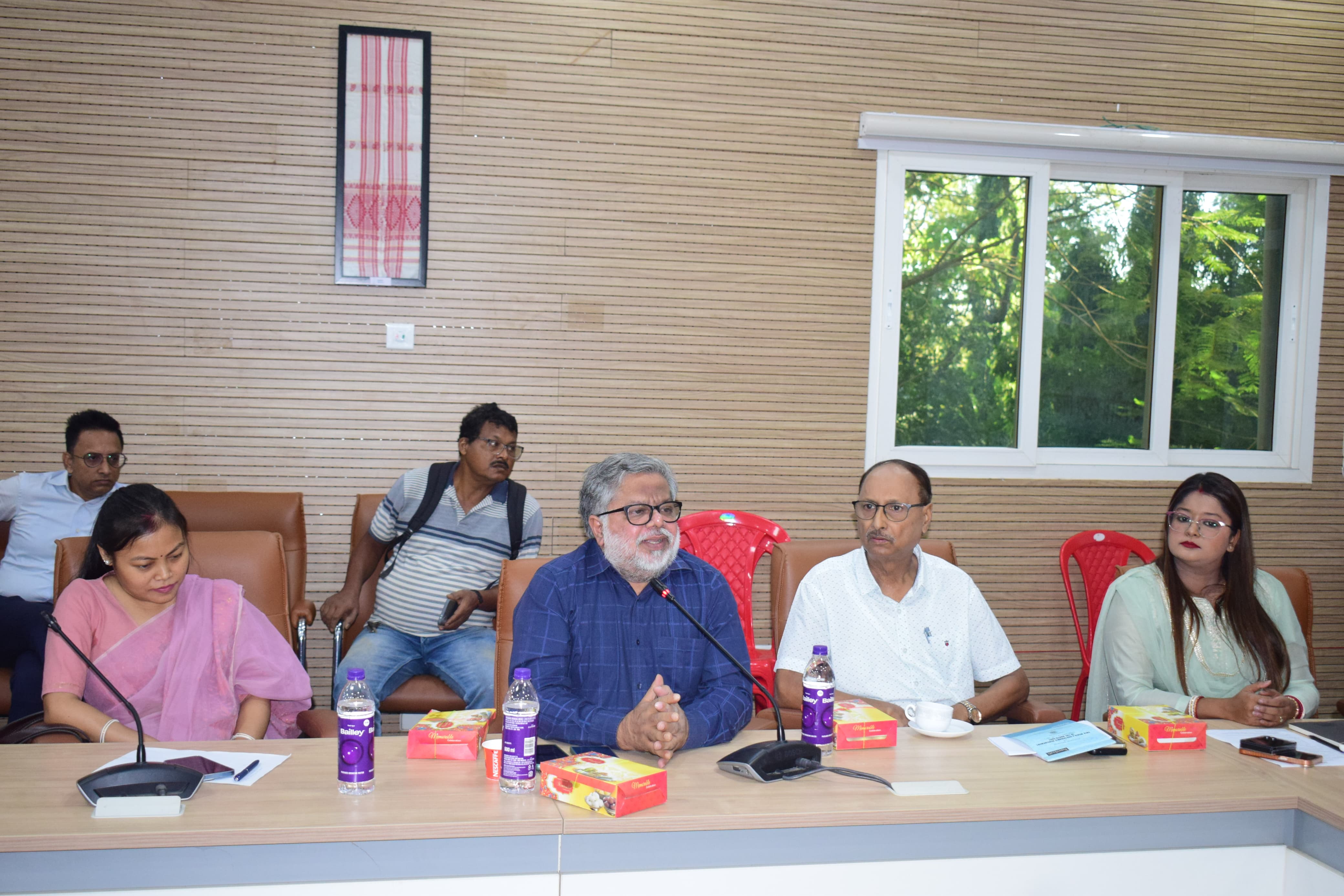
way2barak, November 16: National Press Day 2025 was observed in Cachar with a deeply insightful and thought-provoking programme organised by the District Administration, Cachar, in collaboration with the Regional Office of Information & Public Relations (DDIPR), Barak Valley Zone, Silchar, here on Sunday. The event, chaired by District Commissioner Shri Mridul Yadav, IAS, was held at the new conference hall of the DC’s office and witnessed participation from leading academicians, journalists, students, and media professionals.
Addressing the gathering, District Commissioner Mridul Yadav extended his greetings to the media fraternity and highlighted one of the defining battles of modern journalism, the conflict between speed and accuracy. He stated that in the race to publish news first, the number of fake news incidents continues to rise.DC Yadav also spoke about algorithmic biases that shape public perception across social, political and economic dimensions, often making people believe that curated content reflects reality. Reflecting on the legacy of India’s earliest media reformer, he said that the Raja Ram Mohan Roy Award for excellence in journalism is conferred to media persons who demonstrate exemplary performance in the profession, embodying the values of integrity and courage that Roy stood for.
He further stressed the lack of a sustainable economic model in today’s news ecosystem. From an advertisement-dependent structure, he suggested a shift towards a consumer-driven model of news dissemination. With the rapid advancement of Artificial Intelligence, DC Yadav added, the role and responsibilities of media professionals are set to become even more challenging.
Delivering the keynote address, Prof. Charvak, Associate Professor and Head of the Department of Mass Communication, underlined that the idea of the press today encompasses all media formats and platforms. He revisited the historic struggle for press freedom led by Raja Ram Mohan Roy, describing him as the first true crusader of journalistic truth. Prof. Charvak stated that Roy chose to stop publishing his newspaper rather than allow it to be censored, particularly over disputes relating to news registration. “But today’s reality is far more complex,” he observed, stressing that the contemporary threat lies not in colonial censorship but in the rapid spread of misinformation and disinformation.
Prof. Charvak explained that misinformation, though sometimes unintentional, has taken the shape of a systematic disorder, while disinformation is intentionally crafted with vested interests and sold as a profitable commodity. He warned that digital platforms, dominated by algorithms, filter bubbles and echo chambers, intensify the crisis by delivering content that people prefer, often including falsehoods. Such selective exposure, he said, leads to social overconfidence in unverified information. Strengthening ethical gatekeeping, ensuring algorithmic accountability and fostering social control over digital platforms, he asserted, are essential. He also emphasised the need to embed media literacy from the primary school level and cultivate a habit of not reacting impulsively to unverified events.
The programme also featured insightful addresses by three invited guest speakers.
Representing the Government of India, Panthoibi Singha, Field Publicity Officer, Central Bureau of Communication & PIB, highlighted that excessive and unfiltered exposure to social media has made people volatile in their opinions without proper fact-checking. She stressed the importance of training people to use social media responsibly and urged journalists to avoid publishing fabricated content that may provoke criticism, hatred or violence. Objective and accurate reporting, she said, remains central to protecting press freedom and strengthening India’s democratic values.
While ,veteran media personality and Editor of Samayik Prasanga, Taimur Raja Choudhury, highlighted the long journey of the Indian press since The Bengal Gazette, underscoring the role of the language press in upholding journalistic integrity and credibility.
Shri Choudhary also pointed out the instances of authorities withholding accurate information can inadvertently create confusion in the media. He underlined the need for professional skill, careful study, sincerity, and ground-based reporting to prevent the spread of misleading news. Referring to the rapid expansion of digital media, he said that fact-checking mechanisms must be strengthened to counter misinformation. He also stated that traditional newspapers still retain a dedicated readership and spoke at length about the advantages and risks of AI tools, as well as the negative impact of unregulated social media content. He appealed for responsible journalism that reflects all sides of a story and maintains national interests and integrity.
Speaking on the rising menace of misinformation, Dr Arindam Gupta, Staff Correspondent of The Assam Tribune, described it as “a greasy fog choking newsrooms,” stating the problem is no longer theoretical but deeply operational.
Dr Gupta also explained how misinformation causes panic and confusion. Recalling the Covid-19 pandemic, he stated that numerous unverified claims, rumours, and misleading narratives disrupted public confidence.
He cited the recent instance of the false news of Indian cinema legend Dharmendra’s death, which spread widely across social media and was amplified by hasty reporting without verification, illustrating how digital frenzy and traditional media lapses can together create a national misinformation crisis.
Earlier, Assistant Commissioner and In-Charge, DDIPR Barak Valley Zone, Smt Deepa Das, ACS, delivered the welcome address. Extending warm greetings to journalists on National Press Day, she highlighted the importance of responsible journalism in today’s rapidly evolving information landscape. She expressed gratitude for the presence of the keynote speaker and guest speakers and reaffirmed the District Administration’s commitment to working collaboratively with the media to ensure that development initiatives, welfare schemes, and public services reach citizens with clarity and credibility. She encouraged journalists to continue their mission with renewed dedication, amplifying people’s voices and strengthening democratic discourse.
This was stated in a press release issued by the Regional Office of Information & Public Relations, Barak Valley Zone, Silchar, Assam.